– in 2018 between commissioned art and projects i’m going to finally start on a series i’ve been wanting to create for a while now: a dark fairytales set of drawings. starting with my version of Beauty and the Beast.
next up in january will be my take on the tale of Aschenputtel (and her weeping tree)
We have known that Letter Never Sent is an influence on Episode VIII for just shy of two years, ever since Rian Johnson mentioned the title (alongside Twelve O’Clock High) in an interview with Filmspotting. On Sunday, both films were mentioned again – alongside various others – at the Future Filmmakers panel at Star Wars Celebration Europe (where I got to yell out the words “space bear!” with pride). And given that the cinematic influences for Episode VIII are suddenly back in the spotlight, now feels like a great time to look more closely at Letter Never Sent (the only film of the bunch I have seen so far) and consider what the filmmakers could be taking from it.
To provide some context for this, here’s a synopsis:
The film follows four Soviet geologists who set out into the remotest reaches of Siberia on a mission to uncover diamonds. When the forces of nature turn against them, their mission becomes reduced to the simple matter of survival.
There are two distinct types of influences I think I could be extracted from Letter Never Sent, and while they overlap I think it’s worth separating them out into visual influences and thematic/narrative ones.
So, visual influences:
– Tight, gorgeous and intensely emotional close-ups on actors’ faces.
– Natural landscapes and weather conditions being used to mirror the characters’ internal struggles and emotions.
– Endless vistas being transformed by the camera, gaining an almost alien quality.
And thematic ones:
– Sacrifice, in many different forms (noble and ignoble).
– The hopelessness and futility of unrequited love.
– The triumph of a greater mission over individual needs or desires.
– Man being overpowered and overwhelmed by natural forces.
– A small group of characters being stranded by forces beyond their control, revealing their truest selves when placed amidst extreme conditions.
If you want to read extended thoughts on how these ideas are expressed in Letter Never Sent and how they may feed into Episode VIII, dive beneath the cut.
Three Outlaw Samurai is another film name-dropped by Rian Johnson at the Future Filmmakers panel at Celebration Europe, and of all the titles mentioned this was the one that leaped out to me as the most intriguing. A 1964 chambara film, Three Outlaw Samurai is the debut feature of Hideo Gosha. The central figure of the film is Sakon Shiba, a wandering ronin who comes across three peasants who have kidnapped the daughter of the local magistrate in the hope of coercing him to lower taxes. Sympathetic to their plight, Shiba decides to help them, but in doing so he precipitates a series of events that result in his faith in the systems of honour and law being shattered.
Now, it is safe to say that Star Wars: Episode VIII is unlikely to concern tax disputes (ground already amply covered by the prequel trilogy). Indeed, as with almost all the films mentioned at the Future Filmmakers panel, the influence of Three Outlaw Samurai is most likely to be thematic and/or visual. To break it down, I can detect the following themes:
– Loss of faith in established systems of order, honour and justice.
– The fundamental cruelty and senselessness of the class system.
– Relationships taking radical and surprising 180-degree turns.
The most striking element of the film (and the one I will focus on here – the others will have to wait) was the disintegration of Shiba’s faith in external sources of morality, justice and social order. By the end of the film, he is disgusted not only by the corrupt magistrate, but also by the cowardice and inaction of the peasants themselves. The three peasants who kidnapped the magistrate’s daughter have already been murdered, in an act that saw the magistrate break his solemn vow to Shiba that they would not be harmed, and those they were trying to help are too afraid to act even when they are handed the petition that their friends died for. The systems ordering society – be they judicial, moral or honour-based – are proven hollow. By the close of the film, the samurai of the title only have their own consciences left to guide them. They are lawless, but only because the law demonstrably doesn’t deserve their respect.
Almost everyone in the film betrays someone – you have a daughter defying her father by helping the man who kidnapped her, a samurai ignoring his solemn vow by ordering the deaths of the peasants he swore to pardon, a father forsaking his daughter by selling her to a brothel, a woman betraying her vow to kill her husband’s murderer by agreeing to run away with the killer, a samurai betraying his friends to be with the woman he loves, etc., etc. These betrayals are motivated by many different forces, and adequately representing them would take the mother of all Venn diagrams. (So let’s just say I pass on that – watch the film!)
I don’t see any of these specific themes making it into Episode VIII, but I do see the general idea of betrayal playing heavily into the story. One of the main reasons for believing this is that Episode V, the middle film of the original trilogy, is also very much about betrayals – Luke betrays his duty to train as a Jedi, Lando betrays the trust of his friends, and Darth Vader betrays every fatherly duty conceivable when he chops his own son’s hand off and leaves him a miserable, snivelling wreck who chooses likely death over an evil father/son double act. More specifically, I can also see the idea of betrayal playing into things
on a macro level – whereas the betrayals of The Empire Strikes Back were all very personal and intimate (being between friends and family members), I envisage the betrayals of Episode VIII being betrayals of values, beliefs and systems of order.
Kylo Ren on crusade
Why do I think this? Well, the primary reason would be that Kylo Ren, as he is presented in The Force Awakens, is a fanatical ideologue. As Kylo sees it, he is a crusading knight on a noble and essential mission to purge the galaxy of the Jedi and their sympathisers. He is honour bound to compensate for the mistakes of his grandfather and “finish what he started”. He experiences this responsibility as an unbearable weight on his shoulders, and openly struggles with what he has come to perceive as his ultimate destiny.
Kylo clearly places immense faith in a tenuous system of abstractions. He tentatively trusts Snoke and wants to believe in his promises of the power and glory of the dark side. He chooses to believe that killing his father will bring him the power and stability he seeks, but when he commits the act he is “horrified”
(as per the script). In the aftermath of the act, he seems weakened rather than strengthened – his strategy is nonexistent, his behaviour is erratic, and his loyalties are most striking in their absence. But, of course, The Force Awakens ends with Kylo being ignominiously dragged back to Snoke. As much as the prospect might have appealed to Kylo in those final moments on Starkiller Base, there is no chance of him going ronin because his master proves efficient in scooping him up and restoring him to the evil fold.
So, in The Force Awakens you already have a profoundly ideological (and, in a perverse way, honour bound) character whose beliefs are tested to the extreme. That, in my view, leaves two possibilities for Kylo Ren going forward – his doubts are resolved as he completes his training under Snoke, and he fully commits himself to the dark side; or his doubts persist and grow, and his certainties are eroded still further over the course of Episode VIII.
The Hidden Fortress (1958)
The influences of samurai films – and Kuroawa’s filmography (The Hidden Fortress, in particular) – on the original trilogy are well documented. In those films, the Jedi were clearly analogous to the samurai, being bound by a code of honour and a careful system of discipline. This was manifest by Obi-Wan Kenobi in A New Hope, a figure who embodied the values of Jedi knighthood and taught Luke the ways of the Force. In light of this, the very absence of the Jedi and their teachings is probably one of the most striking elements of The Force Awakens. We meet Maz, who speaks of the Force and its ways, but she is a mere proxy – “no Jedi”, she cannot teach or guide Rey as Obi-Wan could teach and guide Luke. In the absence of any Jedi training or structuring system, then, we only have the dark side equivalent in the triptych of Snoke, Kylo Ren and General Hux. There is no Jedi code on display, but it is clear that Kylo is following some kind of dark side equivalent. So, in the sequel trilogy we almost have an inversion of the original trilogy in that we have dark side ‘samurai’ (after a fashion) and the young Skywalker dashing hopes instead of restoring them.
And then, of course, there is the elephant in the room – the biggest betrayal of The Force Awakens (besides Han’s murder) occurred in the past, when Ben Solo betrayed his uncle and “destroyed” his work to rebuild the Jedi Order. While I certainly don’t expect to see this explained away as a heroic deed following the example of Three Outlaw Samurai (where betrayal is, under certain circumstances, shown to be honourable and commendable), I would be unsurprised to see it being presented as a decision motivated by a ‘crisis of faith’ that saw Ben Solo’s faith in the Jedi irrevocably shattered.
So, with all that blather out of the way, let’s get to predictions!
1. Kylo’s betrayal of his uncle was, to a large degree, ideologically motivated, following some kind of crisis of faith or the discovery of evidence suggesting that the Jedi were inherently corrupt or dangerous.
2. Kylo’s new ordering system for the dark side will be challenged as his old one for the light side was. This is likely to cause some kind of psychological crisis or loss of faith.
3. There is likely to be betrayal at work in other quarters, though this is likely to be betrayal of a more personal nature (think Lando in ESB-level betrayal).
These predictions are dangerously specific (much more specific than those featured in my Letter Never Sent blog, for example) and may be entirely off-base. For all I know, Rian may just be modelling lightsaber battles on Gosha’s sweet, sweet fight choreography. Whatever the case, Three Outlaw Samurai is a great touchstone for any film to reference and I recommend it highly (accept nothing less than the Criterion transfer – you owe it to yourself).
Ahem. This scene right here,
basically. This, righthere:
See Exhibit A:
So I really wanted to leave this meta as
is and let the visuals speak for themselves. I really wanted to leave it as is, to get across the symbolic impact of this scene, because it’s the driving force behind my theory and
honestly the most important part in the movie. But in lit crit when you present
your ideas, you need to back up the crux of your argument with evidence, so
that’s what I’m going to do.
Before I get started, I wanted to
thank all those in the fandom who contributed their ideas to this (honestly, it
was one of the most stimulating discussions I’ve had on art history in ages).
Additionally, I want to give a special shout-out to @a-shipper-despite-herself,
who was instrumental in creating the collages. You’re a trooper.
What follows is an exhaustive, essay-length thesis-length deconstruction on the canon possibilities of Rey/Kylo (and all their
variations), and why the symbolism in the film reinforces the erotic subtext
between them (yes, you read that right. Erotic).
The essay is a roundabout continuation of last week’s meta on Force Bonds and
the similarities between Revan/Kylo and Bastila/Rey (which you can read here).
Spoilers for TFA, EU/KotOR, and general craziness after the jump. Again, if
you’re looking for surprises, don’t follow. I basically give everything away
in detail.
NOTE: Apparently this thing is so big it crashes the mobile app. Either open it through a web browser on your phone or a laptop/desktop to get around it.
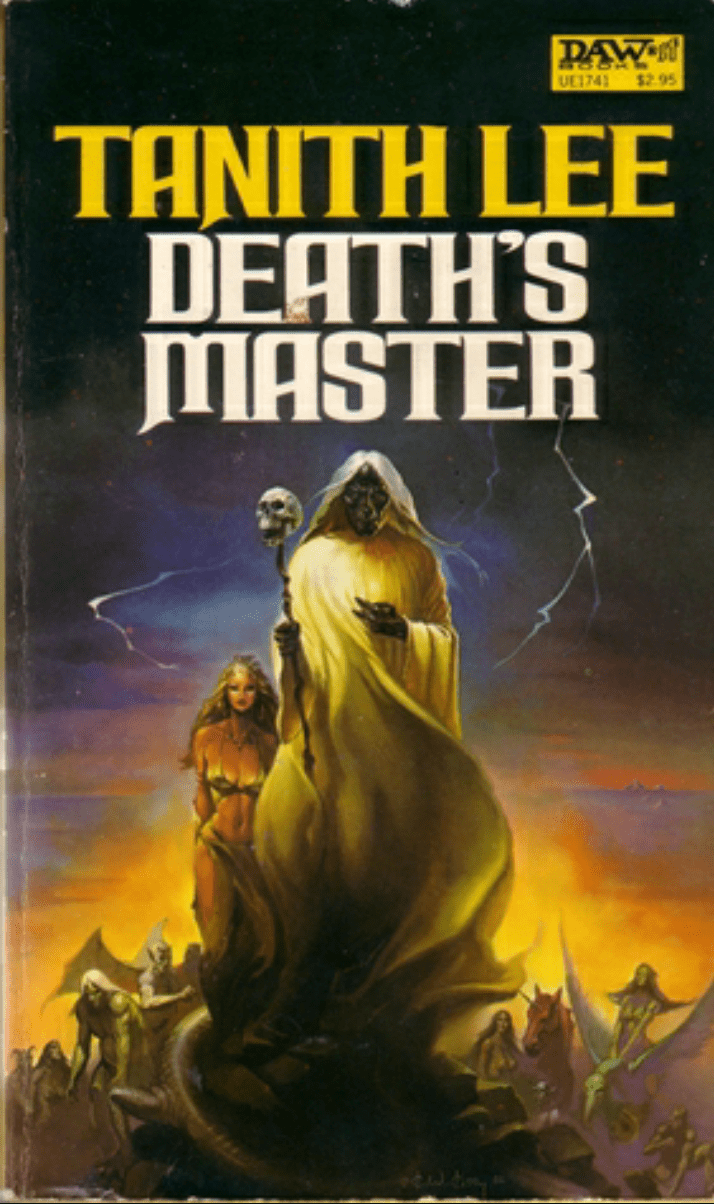
DEATH’S MASTER (Tales of the Flat Earth) by Tanith Lee
DEATH’S MASTER (Tales from the Flat Earth, #2) by Tanith Lee
The soul is a magician. Only living flesh hampers it.“
– from Death’s Master
Death’s Master, winner of the August Derleth Award for Fantasy, is the second book of the stunning arabesque high fantasy series Tales from the Flat Earth, which, in the manner of the One Thousand and One Nights, portrays an ancient world in mythic grandeur via connected tales.
Long time ago when the Earth was Flat, beautiful indifferent Gods lived in the airy Upperearth realm above, curious passionate demons lived in the exotic Underearth realm below, and mortals were relegated to exist in the middle.
Uhlume, Lord of Death, second of thķe Lords of Darkness, King of Shadow and Pallor, makes an unusual bargain which sets in motion an intricate sequence of events that entangle men and gods, queens and kings, sorcerers and witches, and lowly wanderers. When the secret to immortality falls into human hands, dark magic and wickedness are unleashed, testing the bounds of mortal love and sanity, and questioning the nature and purpose of life itself.
Come within this ancient world of brilliant darkness and beauty, of glittering palaces and wondrous elegant beings, of cruel passions and undying love.
Rediscover the exotic wonder that is the Flat Earth.
Reylo vibe recommendation by @k10c2
I strongly second this recommendation. 😍 I’ve decided that each of the ‘Tales from the Flat Earth’ books will get it’s own post.
Very sensual, reminiscent of 1001 nights, featuring a wide cast of characters over the course of 5 books but always returning to beautiful and casually cruel Azhrarn, Lord of Demons who occasionally has a soft spot for humanity.
While the reylo vibe is not as strong in the first of this series it will still make you fall in love with Tanith Lee’s creation and her characters.






 Monsters and Villains