Today’s discussion is about classic British literature references found in the Rey and Kylo Ren dynamic in the Star Wars sequel trilogy.
This episode centers on analysis of Jane Eyre by Charlotte Bronte, and North and South by Elizabeth Gaskell.
In our Jane Eyre and Reylo analysis we discuss:
Similarities between Jane Eyre and Rey, including their lonely, deprived upbringing and first friendships that become as family.
Jane and Rey’s longing for a profoundly spiritual and passionate connection.
The remarkable bond that allowed Jane to hear Rochester’s voice from miles away after they had separated, and that connects Rey and Kylo Ren across the stars. 😉
Jane’s kinship and superficial contentment among the Rivers, which she eventually understands will never fulfill her on the level of her passionate bond with Rochester. We argue that in the same way, Rey will never find true fulfillment among The Resistance and her connections there, and will eventually seek out Ben as Jane sought Rochester – and it will be romantic AF.
We look at Kylo Ren as a Byronic hero, and discuss character similarities between him and Edward Rochester.
We find parallels in the Jane/Rochester romance and the story of Rey and Kylo so far.
Lastly, a quick pit-stop by the horrendous possibilities offered by Ben Solo’s potential “atonement”. Some haters who be hatin’ would like to see him bald and disfigured, whereas others make a case for his eventual death or loss of Force abilities as penance for his sins. We conclude that maiming, Force castration and death are not necessary for Ben Solo to have a meaningful and complete redemption arc.
In our discussion of Reylo and North and South we overview the fiery Margaret Hale/John Thornton romance, including their enemies-to-lovers dynamic
His failed first proposal and their painful separation
Their journey towards each other and eventual reconciliation – and how it all relates to the story of Rey and Kylo Ren.
Stay tuned for part 2 of our discussion, which centers on Pride and Prejudice and other literary works.
Today’s episode features awesome analysis by new Star Wars Connection member Chandra.
We apologize for some trouble with parts of our audio – we are improving our sound for the next part of our discussion, which is coming soon to a galaxy near you. ^^
The heroine is certainly not as attractive as her beautiful best
friend who gets her own interesting plot line.
The
Darkangel (the Darkangel Trilogy, #1) – Meredith Ann Pierce
The protagonist starts out as unattractive, later she undergoes a transformation of
her appearance which represents a turning point in her character development.
This book has lots of female characters of all shapes and sizes.
The main heroine is plain and a bit overweight. Another important
famale character is dead and looks the part. Both have very
attractive love interests.
This heroine is actually very attractive by human standards.
Unfortunately the male protagonist isn’t human and he finds her
appalling and he’s just as ugly to her. The like each other from the
start.
Stolen
Songbird (The Malediction Trilogy, #1) – Danielle L. Jensen
The heroine spends her time around
(mostly) human looking and extremely attractive trolls. She’s not
quite up to their standards.
The heroine is almost a cyborg. Her extremities were replaced by
completely overpowered prosthetics after a horrific assault while
working as a government agent. She’s traumatized, in pain, doesn’t
have full control of her new body and hasn’t come to terms with her
new menacing look. The rock star demon elf protagonist is very much
into her. Yes, really. This book uses and often subverts every trope
known to fantasy and science fiction.
Herb-Witch (Lord
Alchemist Duology, #1) – Elizabeth McCoy
Within the world described in this book the heroine’s look is not only considered
ugly but also shameful as it reveals her barbarian heritage.
The protagonist starts out as rather plain, later she undergoes a transformation of
her appearance which represents a turning point in her character development.
The heroine is fat. She does lose weight while trying to survive
on a hostile alien planet though. The lizard man protagonist is
interested in her either way. All kinds of trigger warnings for this
book: violence, rape, gore, death. It’s also over 900 pages long.
Crazy.
This one stands out as it’s the only book written by a man. It’s
also one of my earliest conscious encounters with an unattractive
female protagonist. For me that was a formative experience. Rather on
the hard side of science fiction the narrative follows the good
looking male protagonist who is a kind of emissary from a culture that values
aesthetics to the extreme coming to a planet where people live by a
more practical approach to life. The female protagonist assigned to him as his assistant is so ugly to him that he can’t
stop staring. After some culture clashing they get married.
I’m always looking for more of my beloved ugly heroines. They are quite difficult to find. So if you know of a book or a movie, please let me know! Reblog this with your suggestions, chat me up, ask or submit. All suggestions are welcome.
TAG: On my blog I use the “unconventional looking / conventionally unattractive heroine” tag.
suggested for Brienne and Jaime (I haven’t read ASOIAF, so I don’t know how they are described in the book but Brienne and Aria from the TV series are certainly great unconventional looking female characters.)
You’d be hard-pressed to find a greater admirer of Eddie’s show-stopping performance as Balem Abrasax (love ya Eddie!), but I find it hard to express how staggeringly wrong he would have been for the part of Kylo Ren. I’m trying to imagine Eddie!Kylo chasing after Rey in the snow, and I can only think of Balem monolouging to Jupiter about murdering her past self. It’s very confusing.
Fawning over Eddie’s masterpiece of shriek/whisper acting aside, I must say that I’m desperately intrigued by what he was given to audition with:
No. So, I was going for, I think, for Adam Driver. They gave me like a Star Trek scene – or like something from Pride and Prejudice. It was one of those films. With films that top secret, they don’t give you the actual lines. So they give you a scene from Pride and Prejudice, but then they tell you you’re auditioning for the baddie. If you’re me, you then put some ridiculous voice on.
Now, the very fact that they wanted actors trying out for Kylo Ren to audition with a piece from Pride and Prejudice is fascinating. What could it all mean!?
Not long after The Force Awakens was released an excellent paper titled “Death and the Maiden” was published addressing the potential of Rey and Kylo Ren — the hero and villain of the Star Wars Sequel Trilogy — forging a romantic bond over the course of the narrative. The author, Ohtze, compared Gothic literature tropes and monster movie iconography to Kylo Ren and Ren’s interactions in The Force Awakens, highlighting the significance of the “bridal carry”. Ohtze came to the conclusion that Kylo Ren’s interest in Rey would remain one-sided because he is the “monster”; however, several months have passed since “Death and the Maiden was penned, and I have decided to analyze The Force Awakens from a very different perspective. After all, Star Wars is neither a Gothic tale nor a monster movie. It’s a fairytale, a children’s story.
Why do I say Star Wars is both a fairytale and a children’s story? There are concrete reasons grounded in narrative deconstruction and the history of children’s literature that I will describe further along in this thesis, but first observe these quotes:
“The movies are for children but some [fans] don’t want to admit that.”
— George Lucas
“[Lucas] then wanted to focus on making a film that was geared more towards kids, and combined elements of mythology and serials of the day, like Flash Gordon. Star Wars was meant to be a new mythology for kids trying to find their way in a bigger world, and [Lucas] felt that some of that was lost when westerns stopped being popular.”
— On the creation of Star Wars
“Star Wars is a fairytale. It’s a fantasy. At the heart of Star Wars is that idea of the Force, which is almost the antithesis of Science Fiction. It’s a long time ago in a galaxy far, far away.”
— JJ Abrams
“Star Wars is more fairytale than true Science Fiction.”
— Mark Hamill
Obviously Word of God claims Star Wars to be a fairytale, but what exactly makes it so?
When most people think of fairytales they will immediately conjure up the image of one of a hundred famous Disney films. Sleeping Beauty, Cinderella, The Little Mermaid, take your pick. Perhaps you are among the camp who views these ancient stories as cautionary tales from the long-distant past. Disney came along, plucked them from old storybooks and chapbooks and plastered family-friendly versions all over the big-screen.
I’ll tell you right now that neither of these interpretations is entirely correct. Yes, fairytales — and indeed, all children’s literature — originated in cautionary tales, but they have evolved over the centuries as much as any form of technology. Fairytales of old are no longer comparable to their 20th century counterparts. Today’s society is dominated by a love of entertainment in its many forms, and no genre is adored by more by both children and adults alike than the modern fairytale.
So what is a modern fairytale?
The Oxford English dictionary defines a fairytale as: “a children’s story about magical beings and lands.” Pretty vague, huh? Acclaimed fantasy author J.R.R. Tolkien added to this definition in his book On-Fairy-Stories, summarizing the modern fairytale — or fairy-story — in his own, much less linear manner.
“What is a fairy-story? […] Stories that are actually concerned with ‘fairies’, that is with creatures that might also in modern English be called ‘elves’, are relatively rare, and as a rule not very interesting. Most good ‘fairy-stories’ are about the adventures of men in the Perilous Realm or upon its shadowy marches.”
As Tolkien declares, the greatest fairytales—that is to say modern fairytales—can follow man or fairy, mundane or fantasy, and are not limited by sub-genre. Joss Whedon’s Buffy the Vampire Slayer is as much a fairytale as Tolkien’s The Lord of the Rings. Star Wars also fits this bill perfectly. It is about men and knights and princesses and monsters doing battle in the great unknown, in a galaxy far, far away.
That is not to say Star Wars is “childish”, just that it was always intended for families to enjoy together—to discuss, share and love as a collective unit. Pixar films are also meant for children, yet they tend to be appreciated far more by adults. That is because—like Star Wars—they can be enjoyed, deconstructed and analyzed on many levels. Star Wars invites all—young and old—to follow the journey of its characters. It is an children’s fantasy fairytale in the vein of The Once and Future King, Lord of the Rings, Harry Potter, The Prydain Chronicles or Percy Jackson & the Olympians, it just happens to be set in space.
Of course, Star Wars isn’t just a fairytale, it’s also a coming-of-age. The coming-of-age is a massive genre of literature and film that details the literal and metaphorical “coming-of-age” of its key characters. The genre is detailed in the following quote:
“[The coming-of-age is] all about the protagonist’s journey from being a child to being an adult. It is a journey that takes a young person from naïve to wise, from idealist to realist and from immature to mature. The path of the protagonist, or the main character, can vary from story to story. […] There will usually be pain and suffering along the way — growing up isn’t easy. However, no matter the narrative direction, the result is that the hero grows from his experiences and in some way loses the childhood innocence that helps steer him towards adulthood.”
Not only do coming-of-age-stories not dismiss any sub-genre, they leak into all genres as well. Both J.D. Salinger’s The Catcher in the Rye and Diana Wynne Jones’ Howl’s Moving Castle are coming-of-age novels, but they couldn’t be more different. The Catcher in the Rye follows struggling adolescent Holden Caulfield as he attempts to recapture his foothold on reality after the death of his younger brother through a series of misadventures in 1950’s New York. Howl’s Moving Castle is set in a fantasy realm and details the adventures of Sophie Hatter, a young woman who is transformed into an old hag by a witch’s spell, and who must turn to the heart-eating wizard Howl for help.
These novels share nothing, minus the overarching coming-of-age theme. The same can be said of Star Wars. Just look at how many narrative classifications can be applied to Star Wars: fantasy, science fiction, western, action, adventure, romance, drama, fairytale, etc. Star Wars includes all of these elements, but it is a coming-of-age first and foremost. It details the physical, emotional and spiritual growth of its key characters as they overcome physical, emotional and spiritual obstacles. The “fantasy” serves as the metaphor the real human condition, the backdrop that allows us to explore the struggle between the Light and Dark within us all.
*Footnote: I do not believe Rey to be in any way related to Kylo Ren. The film itself debunked that theory, you just have to know where to look (see: Maz Kanata’s speech/Kylo Ren and Rey’s interactions). This is a children’s franchise, and the writers are not going to make the same rookie mistake Lucas and the team made in the 70’s.
PART 2: THE HERO AND THE VILLAIN
From this point, we will be discussing the bulk of this essay: the dynamics between heroes and their respective villains in fairytales and other works of children’s fantasy.
We must thus define the “hero” and “villain” in this context.
The Hero
The hero is the protagonist, the main character, the player with whom the audience identifies and about whom the story revolves, in whatever form he or she appears. He is not necessarily the knight on his horse sent to rescue the slumbering maiden and do battle with the dragon. In fact, in most cases, the maiden herself is the focus of the tale. She is the true hero. It is her history and dynamic with the villain that creates the milieu of the narrative. The hero does not have to be heroic. He or she can be, but when it comes to most fairytales and children’s stories, the hero is simply the principal character whose story has been constructed by the writer.
The Villain
The villain is the hero’s counterpart, the antagonist. They are the bad guys, the dark sorcerers, youth-deprived sorceresses and jealous older men. An engaging villain will often serve as the hero’s foil, a character whom the audience can contrast with the protagonist. The best antagonists will be as relatable as their respective protagonists. It was once said that a hero is only as good as his villain, and I happen to agree.
The hero and villain are caught in a never-ending dance that changes from genre to genre and target-audience to target-audience. Archetypes from children’s fantasy cannot be compared to archetypes from adult fantasy (see: Game of Thrones). When it comes to fairytales and children’s stories — which, as we must recall, includes Star Wars — heroes and villains share tried-and-true dynamics. Modern fairytales (or fairy-stories, as Tolkien referred to them) tend to be longer and more complex, but the hero/villain dynamics that became famous thousands of years ago are still made use of constantly today. They have withstood the test of time because they “work”. They are compelling. Why fix something that isn’t broken, am I right?
I’m now going to tell something of a personal anecdote. It concerns my experience with viewing The Force Awakens in theatres for the first time. I had a very unique perspective because I was one of the few who watched this film totally unspoiled. I had seen the trailer some months before and completely forgotten about it. I didn’t know what actors were playing what roles, I didn’t know the characters’ names, I didn’t know anything about the story. I knew one thing: the main character was a young woman.
Now, with no knowledge about any of the characters, Kylo Ren’s introductory sequence struck me in a very unusual way. The following assumption didn’t last long, but it was there, and my sister (with whom I saw the film) had it too! We both thought “he” (the “cloaked knight”) might be an older woman concealing her voice and physique in an oversized costume. Crazy, right? Well, no… actually, it isn’t. There’s a good reason why I thought that might be a potential plot-twist, and I’m going to elaborate upon why right now. It has everything to do with classic fairytale hero/villain dynamics, and two facets that decide practically everything about the potential nature of said dynamics: age and gender.
Why are age and gender so incredibly important where fairytale and children’s story hero/villain dynamics are concerned? Because they create boundaries, they lay down the law. Most of the time they tell you just about everything you need to know about the possible development that will occur between a hero their villain. That is because the “hero” (in the context of coming-of-age fairytales) is by definition a youthful humanoid. The villain must be moulded to complement and challenge the young hero, and we are left with three classic hero/villain dynamics. The hero/villain relationships in just about every fairytale ever written fit into one of these three categories. They are the “the Maiden and the Mother”, “the Son and the Father” and “the Beauty and the Beast”. You would be hard-pressed to find a fairytale that introduces a hero/villain dynamic that does not apply to any of the above. I can’t think of a single example.
The Maiden and the Mother
The first hero/villain dynamic — and possibly the oldest — is the Maiden and the Mother. It concerns fairytales that feature female protagonists, in most cases the maiden or princess. They oppose an older mother-figure (often false) who has become in some way twisted. She is the sorceress jealous of the maiden’s youth or beauty. The heroine must overcome the “mother” in order to come-of-age.
Famous examples include:
Sleeping Beauty – Aurora and the Evil Queen
Snow White – Snow and the Evil Queen
The Little Mermaid – Ariel and the Evil Sea Witch
Cinderella – Cinderella and the Evil Stepmother
Rapunzel – Rapunzel and the Evil Witch
Alice in Wonderland – Alice and the Queen of Hearts
Stardust – Yvaine and the Evil Witches
Howl’s Moving Castle – Sophie and the Witch of the Waste
Coraline – Coraline and the Other Mother
Inuyasha – Kagome and Kikyo
Spirited Away – Chihiro and Ubaba
Matilda – Matilda and Mrs. Trunchbull
The Wizard of Oz – Dorothy and the Wicked Witch
The Hunger Games – Katniss and Coin
The Son and the Father
The male version of the Maiden and the Mother, the Son and the Father concerns children’s fantasy featuring male protagonists. Many are modern, as fairytales were originally meant as cautionary tales for young girls, not necessarily as entertainment. Writers began to twist the Maiden and the Mother to suit male heroes, and the Son and the Father was born. Once again, this “older man” or “male presence” will often have a deep connection to the hero. Perhaps he killed the hero’s real father (i.e. Harry Potter, The Lion King, Avatar), or maybe he is just evil incarnate in the form of a masculine “presence” (i.e. Lord of the Rings). The hero must overcome the “father” in order to come-of-age. The “father” sometimes has an interest in the love-interest of the hero (i.e. Disney’s Aladdin).
Famous examples include:
Peter Pan – Peter Pan and Hook
Arthurian Tradition – Arthur and Mordred
Hamlet – Hamlet and Claudius
Star Wars Original Trilogy – Luke and Darth Vader
Star Wars Prequel Trilogy – Anakin and Palpatine
Lord of the Rings – Frodo and the Ring/Sauron
Harry Potter – Harry and Lord Voldemort
Disney’s Mulan – Mulan and Shan-Yu (Shan-Yu believed her to be a man)
The Prydain Chronicles – Taran and the Horned King
The Graveyard Book – Nobody and the Man Jack
Disney’s Aladdin – Aladdin and Jafar
Disney’s The Lion King – Simba and Scar
Percy Jackson & the Olympians – Percy and Chronos
Inuyasha – Inuyasha and Naraku
Final Fantasy VII – Cloud and Sephiroth
Avatar: The Last Airbender – Aang/Zuko and Fire Lord Ozai
*Footnote: I would like to point out that Star Wars has featured the Son and the Father dynamic not once, not twice, but three times in its history. The Original Trilogy gave us Luke Skywalker and Darth Vader. Luke had to overcome his fallen father through compassion in order to come-of-age. Similarly, Anakin Skywalker fell prey to Emperor Palpatine, his own father-figure in the Prequel Trilogy. The example happens to be an inverted one, as the Prequel Trilogy is the story of Anakin’s fall to the Dark Side.
“If you wanted a subtitle for these movies, it could be fathers and sons. While Palpatine isn’t, we must assume, Anakin’s natural father, he certainly is a father-figure for him.”
— Ian McDiarmid (Emperor Palpatine)
Again, in The Force Awakens, we are introduced to Kylo Ren, the son, and Supreme Leader Snoke, the father-figure and puppeteer. There is even a scene involving Ren comparing Snoke to his real father, Han Solo. Kylo Ren is a perfect representation of just how much tropes can be bent in modern fairytales. He is a villain with his own villain.
The insinuation I am attempting to make here is that Star Wars is — at its core — not the most complex narrative. It is a children’s story, a fairytale, and it follows fairytale guidelines without straying. When Star Wars introduces a hero/villain dynamic, the writers follow through with that dynamic. They use that dynamic to explore the nature of good and evil, of Dark and Light, of youth and experience. The entire history of the franchise tells us this.
Both the Maiden and the Mother and the Son and the Father surround a youth and an older figure whose gender echoes their own. So yes, upon my first viewing of The Force Awakens, I made the automatic assumption that Kylo Ren might have been a woman in disguise because I knew our story had a female hero. I have a background in children’s literature, children’s writing and fairytales, and I had always viewed Star Wars a children’s story and a fairytale. Assuming the hero (Rey’s) villainous counterpart would echo her with regards to gender was only logical. That, and Star Wars had never featured a female Dark Side user before.
So what hero/villain dynamic were we ultimately given in The Force Awakens? You’ll immediately see that Rey and Kylo Ren DO NOT fit into either of the above categories. Rey and Kylo Ren are not the Maiden and the Mother; nor are they the Son and the Father. They are a young woman and a young man, and there is nothing — I repeat, nothing — typical about that. Their dynamic eradicates the two most common and perfectly viable hero/villain fairytale dynamics… and leads us somewhere very, very different, in the direction of the third — and perhaps the most loved — hero/villain dynamic of all time: the Beauty and the Beast.
PART 3: THE BEAUTY AND THE BEAST
The Beauty and the Beast is a trope that has grown immensely popular over recent years, despite being thousands of years old. It is a fairytale trajectory that subverts the Maiden and the Mother and the Son and the Father by casting the villain as a youthful opposite to the hero.
If the hero is a young woman, the villain will be a young man. However, the Beast is never a true villain, he is an anti-villain or a tragic villain. He is temporary in all cases, a character slated for redemption with the influence of the hero. He is the handsome youth under a spell, punished for his wrongdoings. He is the villain, the love-interest and very often the foil in a single entity.
In these tales, the hero’s coming-of-age does not involve the destruction of the Beast. Quite the contrary, the Beauty must “overcome” the Beast through compassion, through understanding and through love. She must break the spell of his past and set him free.
The following are all examples of the Beauty and the Beast trajectory. In all cases the “beast” is first an antagonist of sorts, either a literal villain, an anti-villain or an anti-hero. He or she is a lonely, dismissive and (in almost all cases) violent character with a dark past. The Beauty and Beast’s story arcs lead them to eventually care deeply for each other, to understand each other and come to view each other as equals.
Disney’s Beauty and the Beast – Belle and the Beast
One Thousand One Nights – Scheherazade and Shahryar
Buffy the Vampire Slayer – Buffy and Spike
The Legend of Zelda: Twilight Princess – Link and Midna (female “beast”)
Gossip Girl – Blair and Chuck (yes, Gossip Girl is a modern fairytale)
Inuyasha – Kagome and Inuyasha
Doctor Who – Rose and the Doctor
Wicked – Fiyero/Glinda and Elphaba (female “beast”/rare platonic dynamic for Glinda and Elphaba)
Avatar: The Last Airbender – Aang and Zuko (rare platonic dynamic)
Howl’s Moving Castle – Sophie and Howl
*Footnote: Despite the constant comparison between Rey and Ren’s dynamic and The Phantom of the Opera, I have NOT included the musical among my examples because Phantom of the Opera is neither a children’s story nor a fairytale. It is very much a Gothic narrative (see: how to identify a Gothic tale). The two therefore cannot be compared under the same light. Phantom of the Opera is a dark, tragic love story and Star Wars is an optimistic, idealistic family-driven coming-of-age fantasy. Furthermore, Kylo Ren is NOT Erik, not in character or role.
Star Wars contains as many Gothic elements as it does western elements, but that doesn’t mean anybody should be expecting Rey to be the daughter of the Lone Ranger.
That aside, why do I say Rey and Kylo Ren have been characterized and positioned by the writers to follow the classic Beauty and the Beast trajectory? Why is the fact that they are a young man and a young woman so important to understanding the future of their dynamic? This part of my essay will tackle just that.
If you’ve managed to get this far in this paper, you’re probably very aware of The Force Awakens, Star Wars and the characters Rey and Kylo Ren. Still, I will quote myself a few times from my first meta The Force Bond Awakens in order to re-introduce our hero and villain. A fresh reminder never hurts.
As has been repeated ad infinitum in various analyses, the three main characters of The Force Awakens can all be likened to children who were prevented from maturing naturally as a result of trauma. Rey was abandoned, Finn was stolen from his parents and subjugated to rigorous military training and Kylo Ren’s mind and personality were warped through his innate “gift” of Force-Sensitivity.
Rey: The Beauty
The lovely youth or maiden who stumbles across adventure in the unlikeliest of places, perhaps by falling down a magical well and being transported back in time (see: Inuyasha), being dragged into a magical world of spirits (see: Twilight Princess/Spirited Away), getting lost in the woods and finding her way into an ancient castle inhabited by a monster (see: Beauty and the Beast), or by being chosen as a Slayer in 90′s California (see: Buffy). The Beauty is the innocent soul—the hero—who is about to encounter his or her dramatic opposite. Archaic examples will often put less emphasis on the Beauty, but he or she is by definition the focus of every Beauty and the Beast dynamic.
A dormant Force-Sensitive who was abandoned as a young child, Rey grew up scavenging the wrecks of an ancient battlefield, waiting in vain for her family to return. Rey’s lonely existence is changed forever when she encounters rogue Stormtrooper Finn. The two become quick allies, fleeing together from the minions of the First Order. They commandeer the long-lost Millennium Falcon in order to escape Jakku, and their act of evasion soon leads them to old heroes of the Resistance Han Solo, Chewbacca and Leia Organa. From this point, much of Rey’s journey involves her integration into Kylo Ren’s family and former life. It can be said that she serves as a replacement for the lost Ben Solo. She comes to view both Han Solo and Leia as parental figures, she inherits the Millennium Falcon and Anakin Skywalker’s lightsaber, and there is very much the suggestion that Rey will be apprenticed to Ren’s uncle and former Master, Luke Skywalker.
Rey is the classic Beauty, the quintessential heroine of the modern fairytale. She is as lonely, lost and heartbroken as she is brave, loyal and adventurous. She is a humble down-on-hard-times orphan working day-to-day in poverty just to feed herself. She is the nobody destined for greatness, the archetypical hero. If that doesn’t sound like the “maiden” from just about every classic fairytale I don’t know what does. She is even drawn into the story by her very own White Rabbit in BB-8. She is capable of communicating with this “animal guide” despite other characters not possessing this capacity (see: Snow White, Aurora, Cinderella, etc). Like all “maidens”, Rey is the innocent child on the cusp of her very own perilous journey into adulthood.
*Footnote: Being classified as the “maiden” and the Beauty does not mean Rey is in any way a damsel in distress or a weak, useless female character who exists to “save” Kylo Ren. She is a young woman who is very much capable of taking care of herself (see: the whole movie). She is a modern maiden created for a 21st century audience who also happens to take the position of the hero, but she is still very much a maiden. Although the Beauty and the Beast trajectory involves the maiden’s influence on the redemption of the Beast, the maiden does not exist to absolve the Beast of all sin. He must do that through atonement (see: Buffy the Vampire Slayer). Character archetypes are not intended to be an insult to feminism. Tropes are only as effective as the writer who manipulates them.
See example above. Link is technically the Beauty of this dynamic. Is he a weak, useless character used to redeem the beastly Midna? No. She atones for her mistakes and ultimately breaks her own curse.
Buffy was also a Beauty to both Angel and Spike. Goes to show how much great characterization can impact a tired trope. Buffy was not a prop in Spike’s redemption arc. Did she impact it? Certainly. Did she help him along the way? Of course, but Spike’s redemption was ultimately won through his own efforts.
Kylo Ren: The Beast
The youth cursed to take the form of a lonely monster, the Beast is the counterpart to the Beauty. He or she is often brash, and originates as a villain, an anti-villain, a tragic-villain or (most commonly) an anti-hero. His or her past contains much hardship. Perhaps they were transformed into a monster (see: Buffy, Twilight Princess, Beauty and the Beast, Howl’s Moving Castle) or born from a human and an inhuman (see: Inuyasha, Wicked). Maybe their wife was unfaithful to them and they began to detest women (see: One Thousand One Nights). No matter the cause, the Beast is cursed—literally or metaphorically—by his past, awaiting the nudge they need to find their way again.
Kylo Ren is the fallen son of Han Solo and Leia Organa. He was ensnared in childhood by the mysterious Snoke, head of the First Order. He was manipulated into betraying his family and leaving Luke Skywalker’s dream to restore the Jedi Order in ruins, earning the title “Jedi Killer”. Regarded as the ideal focal point of the Light and Dark, Ben Solo developed an obsession with his maternal grandfather, Darth Vader. He descended to the Dark Side, training under Snoke and becoming leader of the enigmatic Knights of Ren; however, he was never able to completely relinquish the Light from which he was born.
Kylo Ren is without any doubt the archetypical Beast, the youth under a sorcerer’s curse. That curse is not literal, but metaphorical — the curse of the Dark Side. He was manipulated and tortured in childhood, never given a chance to live. Supreme Leader Snoke lured him away from his family, indoctrinating him, training him and moulding him to his will.
Kylo Ren even possesses his own version on the infamous “rose” in Darth Vader’s helmet. He prays to the helmet, revealing his true sentiments to the “ghost” of his ancestor — that the pull to the Light will ultimately take him.
Physically, Kylo Ren is an interesting example of the Beast. He cloaks himself in layer upon layer of black, concealing even his neck, face and natural voice — hiding everything “human” about him, everything that makes him Ben Solo. He is not a beast who wants to be a man, he is a man who chooses to be a beast, both outwardly and through his actions. His personal curse is as much self-inflicted as it is the result of Snoke’s influence.
As is the case with all Beasts, Ren is the creation of his personal origin story and sins. Accepting what Kylo Ren represents to the Star Wars universe is quintessential to understanding his future role in the story, and his future with Rey, the Beauty to his Beast. Just as Kylo Ren does not adhere to a typical hero/villain dynamic, he is unlike any villain we have ever encountered in Star Wars. Kylo Ren is not Darth Maul or Count Dooku. He is not even Darth Vader. He is something new, an amalgamation of contradictory tropes that shouldn’t work together, but inherently do. He is the stoic man and the lonely child, the beast and the prince, the knight and the dragon, the Darkness and the Light. Kylo Ren is a walking contradiction contained in the package of the last Skywalker. He is the grandson of Anakin and Padme, the son of Han and Leia, the nephew of Luke. He is the Legacy of two Trilogies and six films. He is the most important character in the Star Wars universe.
IMPORTANT: All of this analysis would be completely invalid if Kylo Ren was NOT the legacy, but he IS. Kylo Ren’s origin, his characterization and his role in the narrative are what make him the Beast, the sinful monster who is about to be seduced by the Beauty’s light.
Bonus points for this. He might as well have said “There is no conflict.”
The Platonic “Beauty and the Beast” (Light Youth/Dark Youth)
There does exist what could be called a “platonic” trajectory of the Beauty and the Beast. It is a modern take on the dynamic that is bot rare and more difficult to summarize. I will title it the Light Youth and the Dark Youth. The bond forged between these opposites will almost always be a familial one.
Perhaps the best example can be found in in the Broadway musical Wicked (and the Disney ripoff Frozen). Glinda and Elfaba/Anna and Elsa are without any doubt a version of Beauty and the Beast, but because Glinda and Elfaba are both heterosexual females (and Anna and Elsa are sisters), their connections are sisterly.
Platonic Beauties and Beasts will ultimately follow very similar trajectories to their romantic counterparts, but their dynamic will not include any sexual chemistry or romance.
Other great examples of the platonic Dark and Light Youth can be found in Aang and Zuko from Avatar: The Last Airbender, Naruto and Sasuke from Naruto, Gon and Killua from Hunter X Hunter, Koda and Kenai from Brother Bear, Haku and Chihiro from Spirited Away and Rin and Sesshomaru from Inuyasha. Note that the last two are debatable, as both Rin and Chihiro are children. The nature of their dynamics with their opposites are therefore much more open to interpretation, but the trajectory is still identical. One character with a tragic past, one with a blossoming light that can cast away the darkness.
Although the potential is laughably unlikely, if Rey does turn out to be Luke’s daughter, she and Kylo Ren will forge a similar, familial bond. However, I have reasons founded in hard evidence to discount this possibility. This evidence can be found in the film’s soundtrack.
During the bridal carry sequence on Takodana, John Williams made the conscious decision to awkwardly shove a rendition of Tchaikovsky’s famous Romeo and Juliet love theme rise just as Kylo Ren enters his ship with Rey. The theme is played straight and to the point, no mirroring or dissonance or other musical language that might imply any other symbolism than the obvious one.
An excellent comparison of the two.
Furthermore, Kylo Ren and Rey’s motifs contain very bizarre clues. The last three notes of Ren’s motif are the first three notes of Rey’s motif. Rey’s motif corrects the dissonance that can be heard in Ren’s. Rey’s theme “corrects” and “completes” Kylo Ren’s. Again, the meaning should be obvious. Rey “completes” and “corrects” Kylo Ren.
Perhaps more telling is the fact that the three notes that connect Kylo Ren’s and Rey’s themes are in fact the first three notes of Across the Stars, Anakin and Padme’s love song, in-reverse. I’ll let that speak for itself.
A comparison of “Kylo Ren’s theme”, “Rey’s theme” and “Across the Stars”.
PART 4: THE SCAVENGER AND THE MONSTER
In the final part of the essay I will focus on Kylo Ren and Rey’s dynamic as presented in the film — it’s inception, foundation and potential future as evidenced by the entire history of the Star Wars saga and thousands of years of fairytales and children’s stories. This will be the deconstruction of their separate journeys, and a commentary on the fact that they have been positioned by the writers to develop together in future films.
I must start where all stories start: at the beginning.
We meet Kylo Ren on Jakku. He is searching for the “map” to Luke Skywalker, his old Jedi Master. He “denies the truth that is his family” when he cuts down Lor San Tekka.
This scene is often used as “proof” evidencing Ren’s “unredeemable” nature, but I would like to talk about why it — and every other scene involving Ren in the entire movie — is foreshadows his redemption. This film represents the catalyst that will ultimately lead Kylo Ren home.
When does Ren actually murder San Tekka? When he mentions his origins, his family. This is the kind of interpretation we are only made privy to upon multiple viewings of the film. Ren wanted that map so badly he was willing to go against his master’s orders, yet in the very first scene he cuts down a potential key-witness, someone whose mind he could have probed for information? Surely San Tekka had seen the map before… but Ren killed him anyway. He killed him before he even knew Tekka had given the map to Poe, before he knew Poe was watching, before he was made aware of BB-8′s existence.
Ren is a character who reacts very much on instinct. His murder of Lor San Tekka reveals this completely. He kills the old man because of his words, his chastising, his reminder that Ren did not “rise from the Dark Side”. It becomes clear within the first five minutes of the film that Ren is far from indifferent toward his origins. Indifference is the opposite of love, hate is something very different. Hate denotes an emotional attachment, an investment. That investment is what allows Ren to feel a “pull to the Light”.
Ren proceeds to capture Poe and order the slaughter of the villagers, but something very strange happens just as he is about to depart. Kylo Ren spies a Stormtrooper deliberately disobeying him. And what does he do? He lets him go. This decision serves as the singular event that initiates the entire adventure. It is as much the catalyst as Finn’s awakening.
Kylo Ren’s introductory sequence is meant to be contrasted with the remainder of the film, because Kylo Ren’s character arc in The Force Awakens does not revolve around development. On the contrary, he is placed on a downward spiral that leads him to his absolute lowest point.
Ren’s characterization serves as a backdrop for Kylo Ren’s unravelling. He appears so similar to Darth Vader, but in no time at all you are faced with the realization that he is nothing like Darth Vader. That aloof, confidant man is quickly washed away. Ren is in constant turmoil, being torn apart by the two sides of the Force he happens to embody. He prays to his dead grandfathers’ helmet, begging it to show him the way. His eyes are teary behind his mask, his hands balled in fists, his true voice soft and quaky. He is lonely, afraid and in emotional and physical pain, far from at peace with himself.
Throughout much of the film, Kylo Ren appears to be absolutely obsessed with finding the map. The implication is that he has “personal interests” surrounding the map that deviate from Snoke’s plot. He is incredibly driven, following the map — and Rey, Finn, BB-8 and his father — to the forest planet Takodana. However, this interest is somewhat difficult to decipher, because throughout the film Kylo Ren also portrayed an unusual fixation on the “girl” — the “scavenger”.
Upon his arrival on Takodana, he hears word of the map, but ultimately follows the girl into the forest. It is at this point that Kylo Ren’s character trajectory truly begins to come into focus. He becomes the Beast to Rey’s Beauty.
We first encounter Rey on Jakku as well. She is a lone scavenger, a young woman who has been waiting fifteen years for her family to return. As previously established, she is brought into the adventure by Finn — the Stormtrooper whom Kylo Ren allowed to disobey his orders at the beginning of the film, and who betrayed the First Order. Rey escapes with Finn, meets Han and the others and is coincidentally brought to the exact location where Anakin’s lightsaber has been kept. Rey’s strong connection to the Skywalkers — and to Ben Solo — when she is called by the lightsaber. The weapon sweeps her into a Forceback that illustrates past, present and future — Luke Skywalker and R2-D2, the hall of Cloud City, the moment of her abandonment, a rainy battlefield and a snowy wood. She is pursued by a black knight through the vision — he stalks her, storming toward her, saber drawn. The knight is everything she opposes, her worst nightmare in the form of a faceless monster. Fear of her own capacity and of this knight leads Rey to flee the call of the Light, leaving her vulnerable. In the ancient forest of Takodana, she and the black knight with whom her life has become inexplicably entangled — Kylo Ren— are brought together for the first time.
The forest of Takodana is in itself highly symbolic. In age-old fairytales, the maiden almost always meets her prince in a forest. Forests are places of magic, of mystery. A maiden becoming lost in an ancient wood is very often a metaphor for an awakening, for the unknown that must be traversed in order for the maiden to come-of-age. Think Little Red Cap, who had to traverse the Path of Pins or the Path of Needles through the mysterious forest, and who was stalked by the “wolf”. The paths are a metaphor for the inevitability of maturation, the wolf an archaic symbol of male sexuality.
The fact is there has always been something a little “creepy” about the archetypical fairytale prince. He watches the long-lost princess dance from the shadows, stalking her through the trees. I find it hard to believe the writers didn’t draw inspiration from this classic trope, everything from “once upon a dream” to “visions are seldom all they seem.”
These are powerful, ancient tropes, and no competent author would choose to play with them aimlessly. And because this is a modern fairytale, we can expect the tropes to be twisted. Remember the wolf and the prince? Well, Ren isn’t just one of them, he’s both.
Is it a coincidence that Rey and Ren meet in the forest, that they share a moment alone with Ren stalking Rey like a wild animal, toying with her attempts to defend herself? Not at all. In fact, this is where the infamous “bridal carry” Ohtze references so often in Death and the Maiden comes into play.
I would like to veer off-topic for a bit in order to analyze Kylo Ren’s characterization a little more. Kylo Ren is a fascinating combination of Gothic literature and children’s literature. Even I can’t deny the similarities Ren shares with Wuthering Heights’ Heathcliff, or indeed, Shelly’s Frankenstein. But the similarities are ultimately subverted because Kylo Ren also embodies tropes of a separate, contradictory genre. He is as much the lonely young boy shunted off to boarding school by his unassuming parents as he is the Byronic hero or the Big Bad Wolf. He is Toseland from The Children of Green Knowe, or perhaps even more accurately, Edmund from C.S. Lewis’ classic The Lion, The Witch and the Wardrobe. Sent away by his parents “for his own protection”, Edmund is manipulated, enticed and lured away from his siblings by the White Witch. Kylo Ren is as selfish as Edmund, pursuing his own “personal interests” above the orders of his supposed master. He is the boy eating Turkish Delight in the magical sleigh, hoisted by his own false regency. He is responsible for the death of the true father, Aslan, but of course, he ultimately saves the realm beyond the Wardrobe. He betrays the White Witch and, with the help of his family, frees Narnia from her tyrannical rule.
The Gothic literature comparisons are not entirely unfounded. In fact, they can be applied perfectly for about three-fourths of the film. The “bridal carry” scene is without any doubt an homage to the classic monster movie icon of the creature spiriting away the beautiful maiden. However, the trope is ultimately subverted because — as I postulated in Part Three of this essay — Kylo Ren is not “technically” a monster. Rey might call him a “creature in a mask” and a “monster”, but he is undeniably as human as she is. He is a young man who wants desperately to be more, but who ultimately can only conceal the “truth of his family” behind a mask. The second that mask comes off in the interrogation, Kylo Ren becomes a young man. The Gothic comparisons can no longer be applied from here on out, because Kylo Ren is not the Creature from the Black Lagoon or Frankenstein, and Star Wars is not a Gothic tale (see: Part One of this essay).
I think I’ll just let this speak for itself. As much as he might want to be a monster, Kylo Ren is still just a man.
In the interrogation, Kylo Ren watches Rey sleep, crouched on the ground like a small child. There is a sense of submission in him, with the slumbering Rey hovering above. Suddenly she wakes up, and the scene that follows is perhaps one of the most meaningful in the entire film. The sequence serves as the foundation of Kylo Ren and Rey’s hero/villain dynamic. It is what truly moulds them as the Beauty and the Beast.
The scene provides a heavy metaphor for the balance of power in its many forms — female power, male power, Force power, mental power, physical power, emotional power and, perhaps most troubling, sexual power. Kylo Ren looks at Rey’s body, at her lips, her face. He removes his mask — his shield, his line of defence that protects him from vulnerability — for her. He seems to briefly abandon his previous pursuit of the map in order to delve into Rey’s personal thoughts, discovering that he identifies greatly with her. His body-language and actions also betray him completely. He is attracted to her in some way, be that physically, mentally or through the Light Side of the Force she happens to embody. Kylo Ren is, without any doubt, being seduced by Rey’s Light.
And just to prove that the sexual chemistry is indeed there, I present Time Magazine’s review of The Force Awakens:
“In one of the movie’s finest moments, Ren—unmasked and intense—engages Rey in a major stare-down, an unholy duel between the light side of the Force and the dark. The sexual energy between them is strange and unsettling, like a theremin sonata only they can hear.”
The interrogation sequence is peculiar in many ways. In most cases of mind-reading, the audience is made privy to the thoughts and images in the victim’s head (see: Harry Potter). However, we do not see Rey’s thoughts — we hear them through Kylo Ren. He describes her loneliness, her fear, her desperation, her dreams, all while positioned centimetres from her face. There is an “intimacy” between them, a connection, even before Kylo Ren expresses that he “feels it too”.
Kylo Ren is rather beastly in much of this scene; however, the balance of power shifts completely when Rey enters Ren’s mind, emerging dominant over him. She sees his deepest fear, and he is completely taken-aback. The “beast” has once again become a “man”.
The rest of the film further cements Kylo Ren’s fixation on Rey. That fixation appears to transform into some kind of genuine infatuation by the film’s climactic conclusion. He has great admiration for her, and it is spelled out all over his face during their final confrontation in the forest on Starkiller Base.
Kylo Ren has, by this point in the film, unravelled completely. He has murdered his father in the belief that patricide would eradicate the pull to the Light within him. Han died loving his son, forgiving him, and hoping that he would come to forgive him too someday, but Kylo Ren is grief-stricken by the wicked act, weakened, horrified and shocked by his own actions. He shows his regret in his own way, by punishing Finn (the other “traitor”). He expresses that “Han Solo can’t save [him]”. He takes Finn down, and upon doing so, comes face-to-face with the Beauty once again. She grasps his legacy lightsaber, and for the second time, they do battle.
The sequence is breathtakingly beautiful, with snow falling all around them. They are in an ancient wood once more, and Rey is attempting to overcome her adversary — her dramatic opposite, her foil, the “monster” to her “scavenger”. Ren has no desire to harm her, and reveals his true — and perhaps subconscious — intention through a Freudian Slip. As the two forces clash, the planet crumbles around them, and they become caught in a deadlock on the edge of a great ravine. Kylo Ren then offers to show “[Rey] the ways of the Force.” Not Dark Side, but Force. Naturally, Rey has had just about enough of Kylo Ren, and somehow takes advantage of his sudden moment of weakness to defeat him. For a moment — and just a moment — she becomes the “beast”, branding him with her saber, scarring the visage of the young man. It is made very clear in the script that Rey — the maiden — nearly tapped into the Dark Side when she overcame Ren. And yet, as the planet continues to fall to ruin, the two share another moment, staring at each other before Rey is forced to escape. The fissure that separates them becomes a metaphor for everything they will need to overcome, for the physical and metaphysical divide that keeps them apart.
That is the true nature of Rey and Ren’s dynamic. They are equals. Neither is truly dominant over the other. They share in both dominance and submission, one appearing to weaken just as the other grows stronger. They are two sides of the same coin, Yin and Yang, one dark with a little light, the other light with a little dark. They are the Beauty and the Beast, but neither is truly all Beauty or all “beast”. They share in moments of both, the balance of power between them seeming to rise and fall like the mechanisms of a great scale
HOW THIS STORY COULD HAVE BEEN WRITTEN DIFFERENTLY
Interestingly, the writers could have easily made “Ren” an older woman. “She” and Rey could have reflected the classic Maiden and the Mother trajectory, but the writers didn’t go in that direction. Similarly, they could have made Ren a much older man, eradicating all possible romantic tension. They even could have made Kylo Ren develop a fixation on Finn, in doing so creating a subverted prince and princess rescue dynamic. In fact, that would have made a lot more sense in the context of the narrative. Finn was the Stormtrooper Ren ignored despite witnessing him disobey his orders. Rey was just a Scavenger, as Kylo Ren himself pointed out. But no, the writers didn’t go down any of these potential — and indeed, more logical — routes.
Instead, they had Kylo Ren sweep Rey into a bridal carry, watch her sleep from a submissive position, show her his “dreamy” face, reassure her, get too-close-for-comfort, say things like “Don’t be afraid, I feel it too”, search her personal thoughts, cry, beat his own wounds, offer to be her teacher and develop a full-blown infatuation with her. They decided to subvert the “male dominance” trope by having Rey overcome Kylo Ren mentally and physically. They had Rey fill the void Ben left behind in the Skywalker family. They had Rey call Ren a “monster”, an synonym for the Beast. They had Rey, the hero, brand her villain, Kylo Ren, as though he was hers to possess. They had them stare at each other as the world was falling apart around them — lock gazes across a literal and metaphorical chasm.
Why? Why would any writers do this? All of the above is what incites fans to delve so deeply into their narrative “connection”. It is what makes so many educated people so interested in their relationship. It is what makes fans compare them to Belle and the Beast and Buffy and Spike. It is what makes their potential so compelling. But why make their potential narratively compelling in the first place? Why enable crazy people to write 30-page essays detailing their dynamic? WHY?
Why?
WHY?
WHY!?
I have studied children’s stories and fairytales for as long as I have been a lover of entertainment. I don’t think I would be exaggerating if I said the foundation of Rey and Kylo Ren’s hero/villain dynamic is an anomaly within not just the context of Star Wars, but thousands of years of fairytales and centuries of children’s fantasy. It makes absolutely no sense to cast your hero and villain as a young woman and a young man (who is attracted to and has an infatuation with said young woman) unless you—as a writer—are intending to head in a very specific direction? There is no other, not one that has ever seen the light of day in thousands of years.
I don’t say that to suggest The Force Awakens’ dynamic should be anything but what it is. Rey and Ren are a young woman and young man in the same age bracket, one Light and one Dark, positioned to develop against, through and with each other. They are by definition the Beauty and the Beast, and everything about their interactions cements them as such.
When Star Wars starts a hero/villain dynamic, they follow through with that dynamic for the rest of the Trilogy (see: Luke and Vader/Anakin and Palpatine). Star War is not that original, and indeed, it shouldn’t be.
And this leads us to the true thesis behind this entire essay: why would any writers create a Beauty and the Beast fairytale dynamic and a one-sided infatuation between the heroine and the last Skywalker, the Legacy of three Trilogies and six films, the most important character in the Star Wars galaxy if not to go somewhere bold with it?
They wouldn’t, and that is why “Reylo” will not only be canon, it will be reciprocated. We just don’t know how the writers are going to get there.
THE MORALITY OF “REYLO”
Over the past few months I have witnessed what might be called a “vocal minority” speaking out about the potential of Rey and Ren forging a connection of any kind. I have not been personally involved with these individuals beyond a small handful of debates on my platform of choice, but a constant theme that seems to be reiterated to the point of genuine nausea revolves around the idea that “Reylo” as a character trajectory would be in some way “morally wrong” because Kylo Ren is a villain who “abuses” Rey in The Force Awakens. Now, if you happen to be one of these individuals, and you have managed to get this far in my paper, I applaud you. If I have not changed your mind yet, I have a question for you.
What problem do you have with one character in a fictional story learning to feel compassion for another character? You’re dismissing the entire notion of compassion because you think this character does not deserve to be forgiven, that he does not deserve to be loved, understood or given another chance, that he does not deserve to atone for his sins? I’m sorry, but Kylo Ren is not only a member of the Sequel Trilogy character trinity, he is Han and Leia’s son. His father gave his life to take away his pain and forgave him. Han Solo was both a murder victim and a willing sacrifice. He died loving his son, looking into his eyes and hoping that he would find his way home someday. Kylo Ren will be redeemed, no doubt about that.
Leia and Han’s son was abused, twisted and manipulated as a child. He was lured away from his family by a monster. He made disastrous decisions, he committed atrocious crimes, and yet his family still loves him. They see that there is still Light in him, that he struggles, that he is in turmoil, that part of him knows that Snoke is only using him. And yet this “vocal minority” wants to see their hero kill this man — the grandson of Anakin and Padme, the son of Han and Leia, the nephew of Luke, the man who is likely the last in the Skywalker line, the child whose death would spell lifelong grief for all of your previous heroes?
Have you wondered that perhaps this Trilogy is about the girl who ultimately puts the Skywalkers back on the right path? Who helps them through compassion, through understanding and through love? Who shows them that there is a reason to go on? Who guides the lost legacy back to his family, back to those who love him more than anything?
What in hell is wrong with that? That’s not Twilight. That’s not Fifty Shades of Grey. How is that “disgusting”, “supporting abuse” or a “bad message to little girls”? The answer: IT ISN’T.
Both Rey and Kylo Ren are characters who will have an incredibly positive influence on children. Just as Rey is a female character who is not defined by her gender, Kylo Ren is a male character who freely exhibits qualities that young boys are taught constantly to shy away from. He’s incredibly sensitive, brimming with emotion, in tears much of the time beneath his mask—he’s very feminine. More emphasis is placed on Ren’s appearance than Rey’s. The subversion of gender-roles and archetypes is handled gloriously with Rey and Ren because Ren is still masculine, and Ren is still feminine.
Rey and Kylo Ren are a “hero” and “villain” who are very appropriate for a modern audience. They are the perfect constructs of the modern fairytale.
There is no anti-feminist message in a character feeling compassion for any other character or in any human being feeling compassion for any other human being. We don’t have to see eye-to-eye about everything… indeed, there have been circumstances throughout history that have defined and redefined human morality. But without attempting to feel compassion for our opposites, how can we ever come to understand why we support our own beliefs? The world is not made of absolutes, just as the Beauty and the Beast is not a set-in-stone plot. It is a storytelling trope. The best writers will take what is loved about something old and make it new again.
That is what is so fascinating about Rey and Kylo Ren’s dynamic. Rey is not entirely the Beauty, and Ren is not entirely the Beast. They are a retelling fit for the modern era. They are Yin and Yang, opposites that can only exist in perfect harmony by accepting and understanding that they are not all of one thing, that they can only be truly whole at peace with each other.
They are both the Beauty and the Beast.
ON REDEMPTION
Based simply on The Force Awakens I would not call it a leap to suggest that much of this Trilogy is slated to surround the fight for Ben Solo’s soul. He was left a broken, scarred man, staring wistfully across the crack in the world at the woman who brought him to his knees. But… was there more to it than that?
Ring Composition — a narrative formula George Lucas made use of in order to construct the Star Wars storyline — suggests that Kylo Ren’s trajectory will be reversal of Anakin’s. While romantic love couldn’t save Anakin, he was ultimately pulled back to the Light by his son. Familial love did what romantic love could not. Similarly, familial love failed to save Kylo Ren in The Force Awakens. Ring Composition states that Ren can only be saved by what couldn’t save his grandfather: romantic love.
Furthermore, there are countless examples of symbolism and foreshadowing acknowledging the redemption theme that will pervade the future of this Trilogy. I’ll include my favourites from the final script below.
And just then, the LAST BEAM OF SUNLIGHT streaming through the open hatch VANISHES.
Han actually smiles – and reaches out for the dark weapon – but with the light now gone, KYLO REN’S EYES FILL WITH DARKNESS.
At this moment, Kylo Ren murdered his father. Starkiller Base sucked the life from a sun, casting a shadow across the planetary weapon, and across Kylo Ren. The sun’s death heralded Ren’s darkest act. As hope was lost, so too were Ben and Han Solo. The sun, the son and father fell together.
But something amazing happened at the end of the film, creating one of the most meaningful and symbolic images in the Star Wars franchise.
The X-wings ROAR OFF, skyward as the MUSIC SOARS, the PLANET IMPLODES – THE SUNLIGHT IT CONTAINS BURSTS FORTH, and as we get further and further distance from what was Starkiller Base, we witness the REBIRTH OF A SUN. Light restored to a corner of the galaxy.
This is about as descriptive as any script is going to get. We witnessed the “rebirth of a sun”. Rebirth of a sun… or rebirth of a “son”? In English, the words “sun” and “son” happen to be the same. This is a pun that has been used throughout English literature to describe the “prodigal son”.
“I am too much I’ the sun.”
– Hamlet
In a story that surrounds the concept of Light and Dark as two sides of a coin and that involved a sun dying to symbolize the loss of hope as a character violently murdered his own father, having that same sun be “reborn” in a flurry of light is very telling. Kylo Ren was filled with darkness as the sun fell, but after being defeated by Rey (interesting how Rey’s name is also a pun on sun “ray”) he was “reborn” along with the new sun, his father’s eternal resting place.
Below we have an image of the famous interrogation sequence. Kylo Ren is watching Rey sleep. Her form is visibly glowing, light seeming to practically burst from her. Kylo Ren is in the shadows, all in black, admiring her light and majesty. He is quite literally being seduced by the thing he has been trying to avoid: the Light, which happens to take the form of a young woman: the Beauty is unwittingly seducing her Beast.
But we must always remember… even if she doesn’t want to acknowledge it, she “feels it too.”
DISCLAIMER FOR ALL OF THE ABOVE
All of my predictions are founded on the principal that the writers behind this Trilogy actually know what they’re doing (i.e. that they don’t suck). But honestly, they would have to really suck to screw this up. As in beyond any previous level suckage introduced in modern film (worse than The Room). Writers, please don’t suck. I just spent 30 pages discussing how competent you are. Be competent.
“Here endeth the lesson.” – FrolickingFizzgig (also Spike)
Classic reylo meta. More relevant than ever.
Prediction of the narrative direction of Star Wars by analysing the archetypes, tropes and coming-of-age theme of ancient mythology, fairy tales and children’s literature. Referencing works such as Buffy, ATLA, LOTR, Beauty and the Beast, Catcher in the Rye, Howl’s Moving Castle, Spirited Away and many, many more.
This meta holds up VERY well.
THE ROSE AND THE RING by William Makepeace Thackeray
Between the kingdoms of Paflagonia and Crim Tartary, there lived a mysterious personage, who was known in those countries as the Fairy Blackstick, from the ebony wand or crutch which she carried; on which she rode to the moon sometimes, or upon other excursions of business or pleasure, and with which she performed her wonders. When she was young, and had been first taught the art of conjuring by the necromancer, her father, she was always practicing her skill, whizzing about from one kingdom to another upon her black stick, and conferring her fairy favors upon this Prince or that.
Reylo vibe recommendation by @ewa-jednak-chce-spac who says: “This book gives me Reylo vibes due to the fact that the main romantic couple is a prince and a servant girl. He’s the rightful heir to the throne (stolen by his uncle) and a servant girl (later she turns out to be a lost princess from another kingdom). He’s the rightful heir to the throne (stolen by his uncle). The servant girl later turns out to be a lost princess from another kingdom. So it gives me Reylo vibes mostly because of the forbidden love between a guy from royality and a poor girl. 😉
There are some adaptations of this book, including a Polish TV series from 1980s. A piece of trivia: In the Anglo-Saxon world this book is treated (as it was intended) as a satirical book, while in Poland it’s treated as a fairytale story for children. ;)”
Do you have a REYLO VIBE recommendation? Submit or contact me!💙💙💙
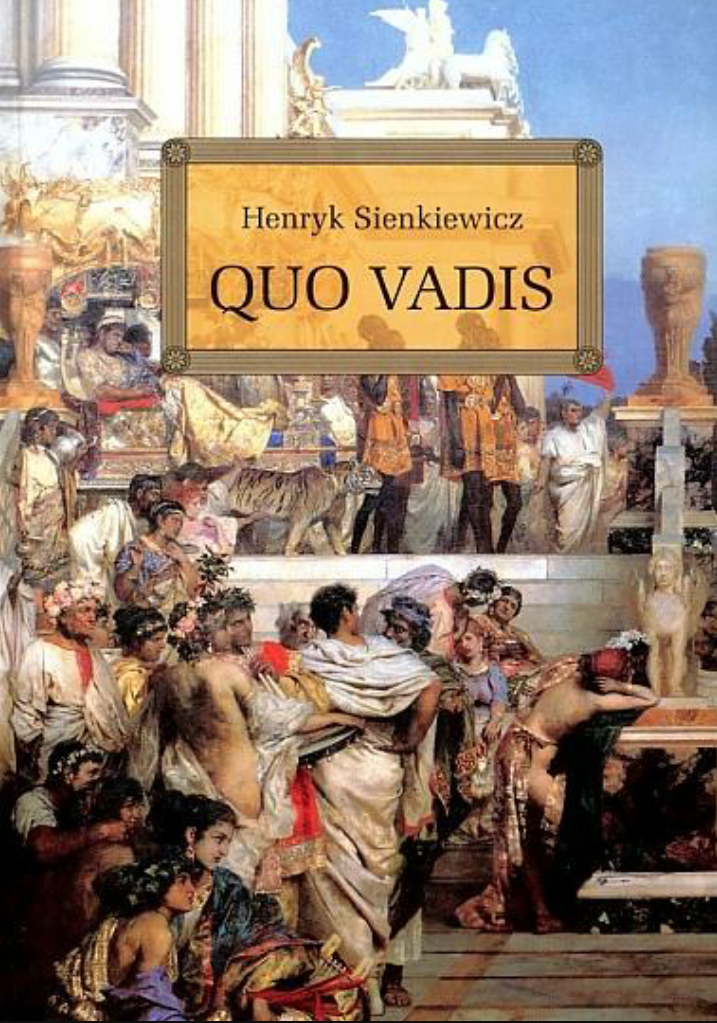
QUO VADIS by Henryk Sienkiewicz
Rome during the reign of Nero was a glorious place for the emperor and his court; there were grand feasts, tournaments for poets, and exciting games and circuses filling the days and nights. The pageantry and pretentious displays of excess were sufficient to cloy the senses of participants as well as to offend the sensitive. Petronius, a generous and noble Roman, a man of the world much in favor at the court of Nero, is intrigued by a strange tale related by his nephew Marcus Vinitius of his encounter with a mysterious young woman called Ligia with whom Vinitius falls madly in love. Ligia, a captured King’s daughter and a one-time hostage of Rome, is now a foster child of a noble Roman household. She is also a Christian. The setting of the narrative was prepared with utmost care. Henryk Sienkiewicz visited the Roman settings many times and was thoroughly educated in the historical background. As an attempt to create the spirit of antiquity, the novel met with unanimous acclaim, which earned the Nobel Prize in literature for the author in 1905. As a vision of ancient Rome and early Christianity it has not yet been surpassed, almost a century later.
Reylo vibe recommendation by @ewa-jednak-chce-spac sees similarties between Quo Vadis and the reylo dynamic due to the fact that one of the main plots involves a romantic storyline between a violent young soldier from a noble family (Marcus Vinitius) and a young, innocent, christian woman(Ligia). Marcus is obsessed with the Ligia and kidnaps her and proceeds to get a redemption arc.
Do you have a REYLO VIBE recommendation? Please contact me or submit.💙💙💙
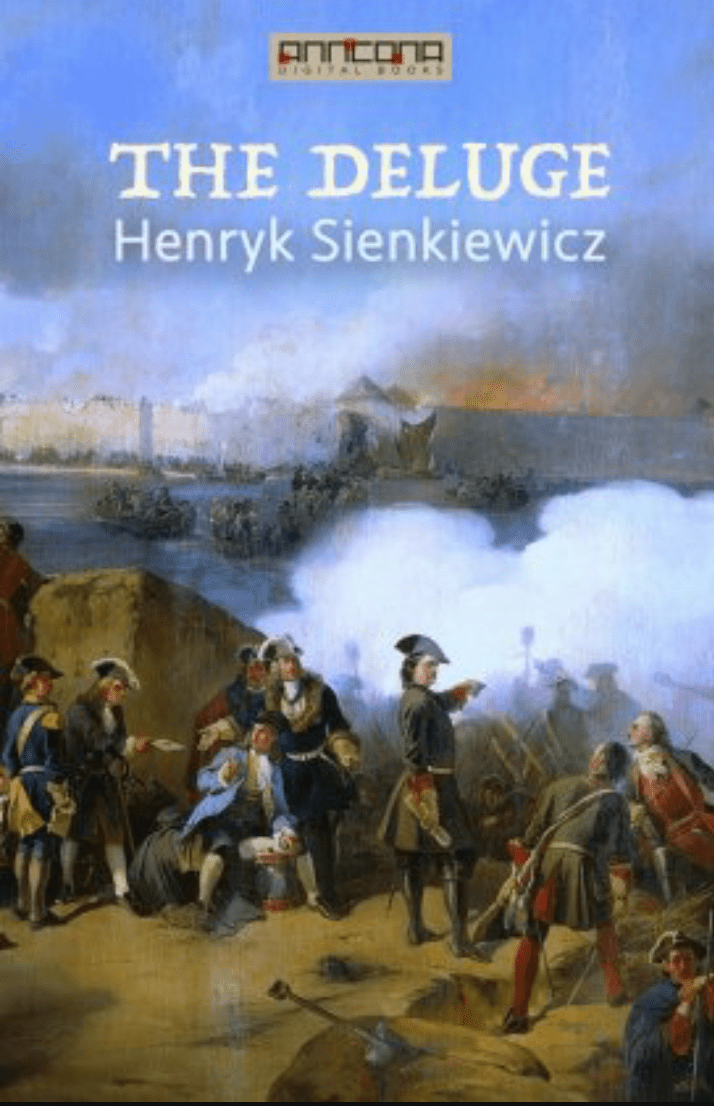
THE DELUGE by Henryk Sienkiewicz
Following on the success of With Fire and Sword, this second book of the classic Sienkiewicz Trilogy thunders across the vast historical canvas of Eastern Europe in the 17th Century, and its great human message of war, struggle, love, betrayal and redemption rings just as powerfully today as it did when it was first published in Polish in 1886.
The Deluge is a literary masterpiece, almost unknown today outside its native country, that sweeps across the plains and forests of Poland, Lithuania and Prussia in an epic tale of treasons, faith, selfishness, sacrifice and heroic valor, set against the bloody background of the Swedish invasion of 1655-1657, in an uncanny parallel to the events of our own decade, when an exploited and exhausted Poland threw off the yoke of foreign domination, reacquired its freedom, and opened the doors to liberty in East and Central Europe. Told by a master storyteller who won the Nobel Prize for Literature in 1905, this scorching tale of battles, passions, and intrigues is the structural and thematic heart of the Trilogy, Poland’s most enduring and popular prose epic. Like the other two books of the Sienkiewicz Trilogy, The Deluge not only depicts vital historical events but mirrors a people’s soul. It is a masterful blend of history and imagination that shows whole nations as well as individuals caught up in earthshaking events and fighting for their lives, and rediscovering themselves through their own commitments.
A new cast of fictional and historical heroines and heroes joins the unforgettable characters of With Fire and Sword, brought to life with a depth seldom found in historical fiction. There is the turbulent and self-willed Andrei Kmita, misled into treason, who triumphs over his enemies as well as himself; the beautiful and thoughtful Olenka whose decency and goodness confound a treacherous villain and inspire the hero; the valiant Father Kordetzki who defends Poland’s holiest shrine and wakens the conscience of a nation; the tragically ambitious Prince Yanush Radzivill and his ruthless cousin, Prince Boguslav, who betray their country; and dozens of others. As in all three novels of the Trilogy, The Deluge dazzles with a gallery of Kings, chancellors, generals, magnates, mercenaries, brave soldiers, heroic spiritual leaders and other historical figures who created the era in which this book is set. Rich in action, drama, humor, faith and simple wisdom, they are part of one human experience, not confined to any single nation; as thrilling, true and challenging today as in their own time, and vital to our understanding of the new Europeans.
First put into 19th Century English more than 100 years ago, and now largely forgotten in the western world, The Deluge comes brilliantly back to life in this rich new adaptation directly from Polish, made by a Polish-born American novelist for the modern reader, and it illuminates the national character of the extraordinary people who are now taking center stage in a free and democratic Europe.


 Monsters and Villains