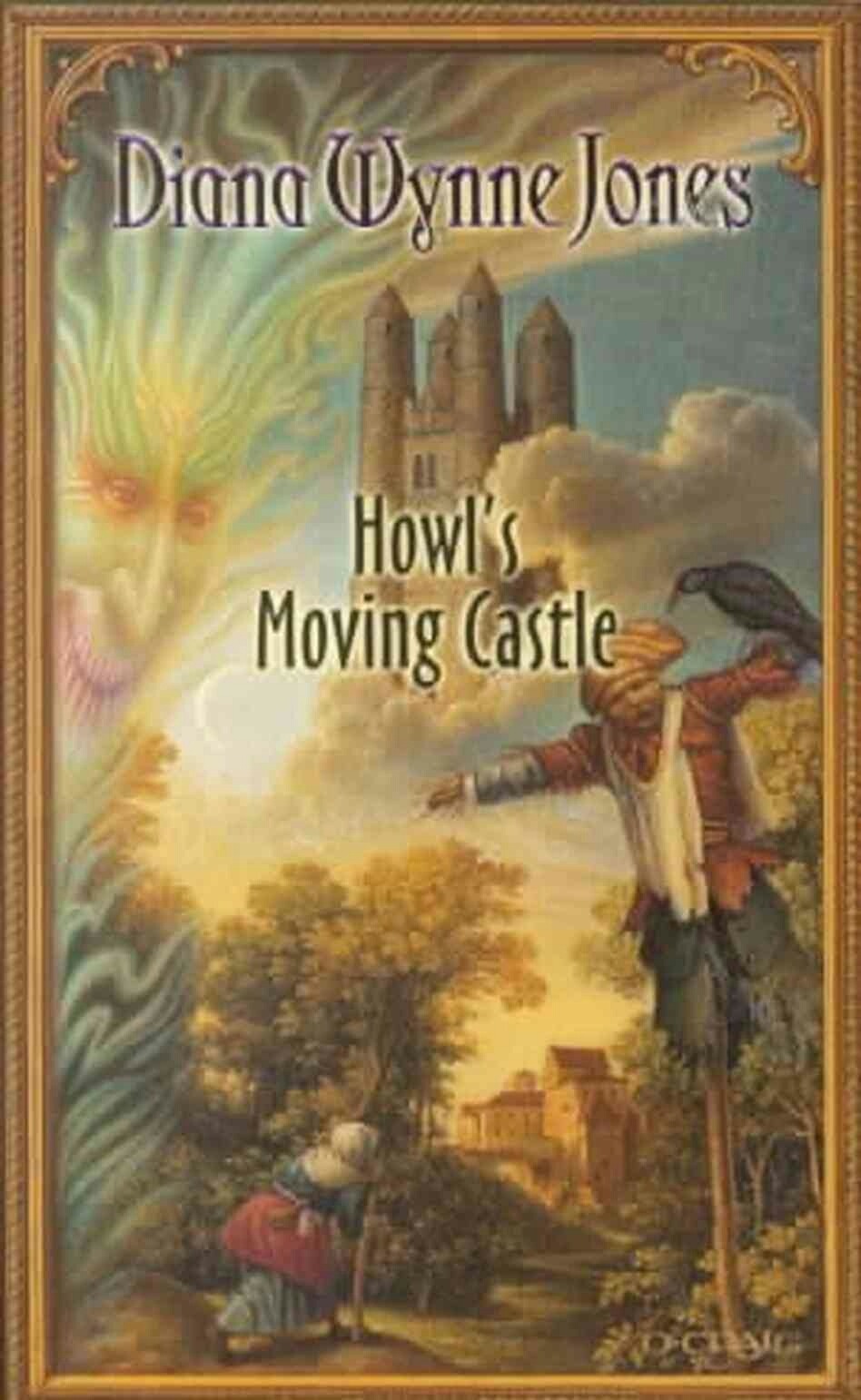
Sophie has the great misfortune of being the eldest of three daughters, destined to fail miserably should she ever leave home to seek her fate. But when she unwittingly attracts the ire of the Witch of the Waste, Sophie finds herself under a horrid spell that transforms her into an old lady. Her only chance at breaking it lies in the ever-moving castle in the hills: the Wizard Howl’s castle. To untangle the enchantment, Sophie must handle the heartless Howl, strike a bargain with a fire demon, and meet the Witch of the Waste head-on. Along the way, she discovers that there’s far more to Howl—and herself—than first meets the eye.
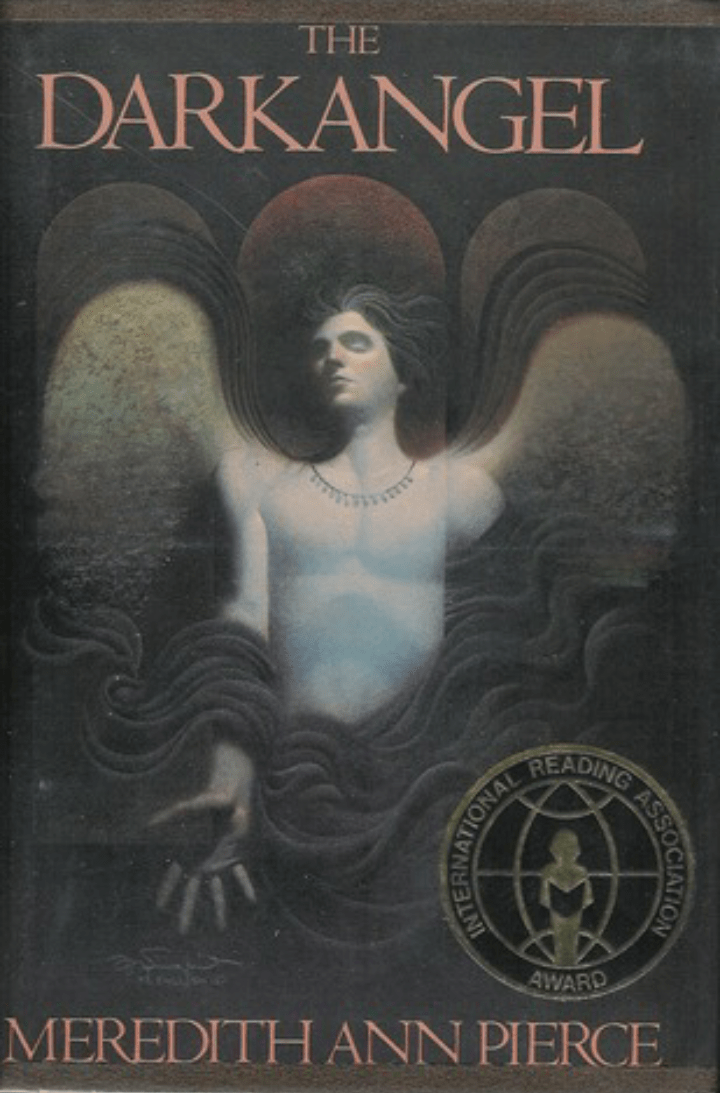
THE DARKANGEL (DARKANGEL TRILOGY #1) by Meredith Ann Pierce
Aeriel is kidnapped by the darkangel, a black-winged vampyre of astounding beauty and youth. In his castle keep, she serves his 13 wives, wraiths whose souls he stole. She must kill him before his next marriage and comes into full power, but is captivated by his magnificent beauty and inner spark of goodness. Will she choose to save humanity or his soul?
You think this is your average YA novel? Think again! First published in 1982 it came long before the supernatural love interest was trending. I read this book as an adult and I never once had the feeling that I couldn’t relate to the young heroine. This trilogy features incredibly imaginative worldbuilding, a wealth of interesting secondary characters and universal themes including love, friendship and betrayal. I was crying by the end and I mean crying, like actual salt water leaking from my eyes.
Do you have a REYLO VIBE recommendation? Submit or contact me!💙💙💙
This is (my apologies in advance) an extremely long continuation of the analysis I presented in the Descent, in which I explain the next step of the archetypal Heroine’s Journey as presented in The Force Awakens.
Consider yourself warned: this presupposes a relationship between Rey and Kylo Ren which transcends the familial. Hic sunt leones.
Classic reylo meta from the early days of the fandom.
Incredibly deep and thought-provoking meta shining a light on the parallels between reylo, ancient myths, folktales and works of literature such as Eros and Psyche, Beauty and the Beast, Prince Lindworm, East of the Sun, West of the Moon, Bluebeard, Dracula, Phantom of the Opera, Crimson Peak… By explaining the psychology behind these kinds of stories it is made clear how the dynamic of uniting with the monstrous or “other” man is really a story of female self actualization.
Also the prediction list towards the end holds up VERY well.
This is probably my favourite reylo meta.
A *very serious* analysis of LABYRINTH by Nostalgia Chick aka Lindsey Ellis.
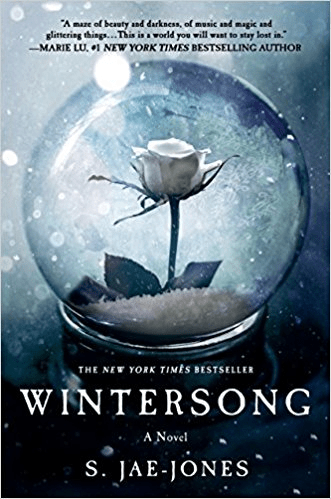
All her life, nineteen-year-old Liesl has heard tales of the beautiful, mysterious Goblin King. He is the Lord of Mischief, the Ruler Underground, and the muse around which her music is composed. Yet, as Liesl helps shoulder the burden of running her family’s inn, her dreams of composition and childish fancies about the Goblin King must be set aside in favor of more practical concerns.
But when her sister Käthe is taken by the goblins, Liesl journeys to their realm to rescue her sister and return her to the world above. The Goblin King agrees to let Käthe go—for a price. The life of a maiden must be given to the land, in accordance with the old laws. A life for a life, he says. Without sacrifice, nothing good can grow. Without death, there can be no rebirth. In exchange for her sister’s freedom, Liesl offers her hand in marriage to the Goblin King. He accepts.
Down in the Underground, Liesl discovers that the Goblin King still inspires her—musically, physically, emotionally. Yet even as her talent blossoms, Liesl’s life is slowly fading away, the price she paid for becoming the Goblin King’s bride. As the two of them grow closer, they must learn just what it is they are each willing to sacrifice: her life, her music, or the end of the world.
I really like this book. It reads a little bit like Labyrinth fan fiction. Of course it features original characters. But the author is actually pretty upfront about it.
Occasional self-reblog.
Original story, strongly influenced by the movie Labyrinth.
Do you have a REYLO VIBE recommendation? Submit or contact me! 💙💙💙
Ah Labyrinth…where do I even start? I love this movie and I have loved it for a long time. Jareth was one of my first childhood crushes. I was doomed from the beginning….always the villains.
The movie is charming, the puppets are amazing, the tunes are catchy, the heroine is plucky and the villain sexy. Perfect.😍
Occasional self-reblog.
Do you have a REYLO VIBE recommendation? Submit or contact me! 💙💙💙
“Who is that man? The one staring at us? The nasty dog… He looks like he knows what I look like without my shimmy.” – Scarlett O’Hara about her first encounter with Rhett Butler, Gone With the Wind (1940).
Female protagonists have been paired romantically with “mad, bad, and dangerous to know” types since the beginning of and long before the advent of cinema. Although of chagrin to many “nice men” and socially concerned women, this ancient trope speaks to female desire as well as the deeply ingrained cultural idea that female sexual desire is dangerous. Ergo, the male character becomes an outward expression of that danger. For women who have been raised to fear their sexuality, the dangerous and seductive male character is a safe way in which to act out “dangerous” sexual desire. Next, the villain or antihero represents challenge and acts as a foil for personal growth and exploration within the heroine. Last, the villain/antihero is defeated and either banished or his inappropriate masculine power replaced with appropriate masculine power; this serves as a device for female empowerment. In this essay I shall support these assertions by drawing parallels between two modern fantasy movies. The first, 1986’s Labyrinth, features an overt heroine-villain romantic interest and the second, 2015’s Star Wars: The Force Awakens (hereafter referred to as The Force Awakens), features a foreshadowed heroine-villain turned antihero romantic arc. I shall also draw from psychology and classic literary and mythological tropes to bolster my examples.
Section I: The Maiden and the Frightening Unknown
We are often first introduced to our heroine, the young maiden who is presented in a childlike state, her sexuality unawakened. In Labyrinth, we meet Sarah who still plays with her “toys and costumes”. In The Force Awakens we meet Rey who, although living a difficult life on the brink of starvation, still retains a childlike quality in wearing a rebel pilot helmet and keeping a rebel pilot doll.
Sarah:
Rey:
Most notably, both heroines are presented as young and inexperienced females who become frightened when the consequence of their action calls them to their hero’s journey.
Section II: Into the Woods and Spirited Away
In Labyrinth, Sarah wishes her baby brother, symbolic of her own childhood, away to the Goblin King and is frightened by the aftermath of goblins scampering about her parents’ bedroom (an apropos setting as adult sexuality would be frightening to childlike Sarah), popping in and out of drawers and out from under the bed. Thunder and lightening crash. After Jareth appears he spirits her away to his labyrinth, which is both surrounded and permeated by a glittering autumnal forest.
In The Force Awakens, Rey is called by the Skywalker legacy lightsaber. Touching the lightsaber induces a frightening vision in which she encounters the masked Kylo Ren. After the vision, the Wise Old Woman of the story, Maz Kanata, tells her that the belonging she seeks is not in whomever she is waiting for (her family) but ahead of her. Wanting nothing to do with her apparent destiny, she runs down the steps of Maz’s Castle into a forest where her next encounter with Kylo further frightens her. In her vision, Kylo appears twice as a masked man with a raised lightsaber (more on this in Section IV), the second appearance taking place in the snowy forest of Starkiller Base. When Rey actually encounters Kylo in the Takodana forest, he bridal carries her across the threshold of his ship and spirits her away to the underworld of Starkiller Base. (By the way, the bridal carry of a young woman by a monster or young man, and Kylo/Ben is both, means one of two things in stage: a villainous crush or foreshadowing romance, either immediate or distant future. I leave it to you to imply the narrative direction this trilogy is going.)
In fairy tales and mythology, Dark Forests or Enchanted Forests carry multiple meanings, among which are sexuality, the subconscious, mystery, and our primal selves. Most importantly, the forest represents a rite of passage. Red Riding Hood meets and defeats the Big Bad Wolf in the forest. Rama takes refuge in the forest for fourteen years before rescuing Sita. Snow White becomes lost and is eventually awoken with the Kiss of Life in the forest. Beauty chases her lost father into the forest only to find the Beast. Thus, into the forest Sarah and Rey go, for it is here where they must encounter their Shadow, Dark Side, or Subconscious and shine Light on it so that they can transform from childhood to adulthood, from unawakened to awakened.
Section III: Temptation Presents Itself or Enter Boy Trouble
In every hero’s journey, something or someone who turns the hero’s world upside down must enter the picture in order for the hero to develop. This is no different for our female protagonists, whose worlds are upturned by the arrival of the tempting male antagonist. Enter Boy Trouble.
Needless to say, there appear to be some commonalities in presentation. Both Jareth the Goblin King and Kylo Ren/Ben Organa-Solo wear black clothing, have sharp, angular features, and appear to spend an inordinate amount of time on hair maintenance. In personality, Jareth and Kylo are haughty, intelligent, and display dry or deadpan senses of humor. They are both magic (Force) users, men of power, and royalty with Jareth being King of the Goblins and Kylo being the son of Princess Leia Organa.
Most importantly, their initial shots serve to establish that the female protagonist is physically attracted to her dangerous but alluring antagonist. During their presenting shots, both men’s features are sexualized using make-up and and lighting, their less flattering features deemphasized, and both men are presented at flattering angles (for Kylo, this initial unmasking is arguably his most attractive shot in the film, followed closely by his close-ups with Rey during their lightsaber duel). Note both heroines appear taken aback and enchanted by their antagonists. Rey even gives Kylo “elevator eyes”, then pointedly looks away when he approaches, stealing not one but two glances back at him.
Sarah’s reaction to the appearance of the Goblin King:
Rey is captivated as Han Solo tells of “one boy” who destroyed Luke’s new generation of Jedi:
Rey’s reaction to Kylo’s unmasking:
The following point will be covered more in depth in Section IV, but it is appropriate to note in this section that during both initial presentations, serpent symbolism is employed. Jareth throws a snake at Sarah and when Kylo unmasks we hear a snake hiss and rattle. The serpent is an ancient trope; in the Garden of Eden the snake tempted Eve with the apple from the Tree of Knowledge. Snakes represent phallic imagery, deception, and temptation; all three ideas apply although Kylo’s deception (that he is a man rather than a creature) is only a deception from Rey’s perspective. (Without wading too deeply into the weeds here, the film strongly suggests Ben Organa-Solo is not a monster and has a forthcoming redemption arc.)
In addition, each antagonist is also a Death or Hades figure (Please make time to read Death and the Maiden by @ohtze for in-depth analysis). Jareth and Kylo, dressed in black and sweeping Sarah and Rey away to their respective representations of the Underworld, the Underground and Starkiller Base, represent the death of childhood innocence and the rebirth of mature sexuality.
Jareth spirits Sarah away to the Underground:
Kylo (Hades) bears Rey (Persephone) away to the depths of Starkiller Base (the Underworld) on his ship (chariot) led by four TIE fighters (horses):
Finally, both antagonists serve as empathetic foils for their respective heroine’s character development. Both antagonists have similarities with the heroine. Sarah is an intelligent bookworm; Jareth is witty and intelligent. Rey and Kylo engage in what has been affectionately dubbed by fans as The Nerd-Off, a subtle battle of wits that takes place during her interrogation. Rey begins reciting droid specifications and Kylo cuts her off, saying he needs a map it is carrying and going into unnecessary detail about having put together all the other pieces of the map by recovering them from the archives of the Empire. That’s right, One Boy just told What Girl he spends all his time in archives as a point of pride. In the novelization, he also lets her know that he too knows about general droid specifications (thank you very much). Mirror mirror on the wall, who’s the nerdiest of them all? Both antagonists also relate to the heroine’s loneliness and isolation. The Goblin King sings to Sarah lyrics such as “the lost and the lonely”, “there’s such a sad love deep in your eyes”, and “live without your sunlight, love without your heartbeat”. As Kylo reads Rey’s mind, his tone is soft and empathetic. “You’re so lonely. So afraid to leave. At night, desperate to sleep, you imagine an ocean. I see it. I see the island.”
Each protagonist and antagonist pair is presented as two sides of the same coin. While Sarah’s development lies in realizing that the world is not fair, a fact the Goblin King does not fail to remind her of on several occasions, Jareth too displays a haughty, entitled attitude. Kylo/Ben and Rey are presented in a more Yin and Yang manner. Kylo is typically shown as a rage-filled, selfish character (tantrum throwing and ultimately choosing to kill his father) with moments of compassion (letting Finn off the hook in the opening scene and attempting to interrogate Rey first in a non-invasive manner then empathizing with her loneliness and isolation). Rey is typically shown as a compassionate character (choosing BB-8’s well being over more food rations than she has likely ever seen before) with moments of sheer rage (slashing Kylo’s face after she has already disarmed him). In the case of Kylo/Ben, we can presume that Rey will also serve as a foil for his character development as he makes the transformation from Kylo Ren back to Ben Organa-Solo.
Section IV: Sometimes a Lightsaber Isn’t Just a Lightsaber
Remember that part in Harry Potter and the Goblet of Fire that talks about the champions’ wands being flexible or rigid and whose wand was which length? Did you giggle at it? If so, then you did exactly what the author intended. Phallic imagery is purposely placed in literature and films, especially coming of age fantasies, as a signifier of potency, whether sexual or otherwise. Phallic imagery abounds in both Labyrinth and The Force Awakens. The following represent some of the phallic imagery present within both films.
Jareth warns Sarah, “Don’t defy me” then throws a snake at her:
Jareth and his cane:
Let’s not forget Jareth’s pants magic pants:
Hasn’t anyone told Kylo it’s bad manners to put your lightsaber in a stranger’s face?
I’m so not even kidding about this one. Check out the “tip” of his index finger. There you go. Now you can’t unsee it:
Note the positioning of the lightsaber as Kylo approaches the “girl he’s heard so much about”:
Thanks, Wedge. Monster, indeed.
Section V: Female Sexuality Awakens
Sarah is pulled into the Labyrinth’s world of sexual awakening when she summons Jareth, who shows up in the window of her parents’ bedroom. Jareth tells her he has brought her a gift. “It’s a crystal, nothing more. But if you turn it this way, look into it, it will show you your dreams.” Later in the film, Jareth sends her just such a crystal, which transports her to a highly sexualized ballroom with adult men and women wearing phallic masks (check out the horns and noses). She is the only character wearing white, symbolic of purity and virginity. After stumbling around the room, startled by the lascivious behavior she sees, she encounters Jareth who sweeps her in for a “dance” while singing to her, “As the pain sweeps through makes no sense for you. Every thrill is gone, wasn’t too much fun at all. But I’ll be there for you as the world falls down”. A song about the loss of virginity if I ever heard one. However, catching sight of a clock, she realizes she is running out of time to save her baby brother (innocence) and smashes a mirror, shattering the illusion.
Rey and Kylo engage in their own “dance”, during which the most transparent veiled pick-up line in cinematic history (aside from “Forget about your innocence the baby” of course) occurs when Kylo tells Rey, “You need a teacher. I can show you the ways of the Force.” First, “You need a teacher” is an established trope both in cinema/literature and real life for initiating romance. Men like to teach women of interest activities, whether driving a manual transmission or playing video games, as an evolutionary mechanism of showing fitness to mate. It’s a way of saying, “Look at all the skills I know and can show you. You should mate with me because you can count on me for survival skills.” (Yes, I’m aware of the not so feminist implications of this. I didn’t write the evolutionary handbook; I’m just its messenger.) Next, long time Star Wars fans will recall that typically when a Dark Side user is speaking about the Force or trying to recruit new members, some variation of “the power of the Dark Side” is used. Even Kylo, earlier in the film, tells Lor San Tekka, “I’ll show you the Dark Side”. There is a reason Kylo’s proposition to Rey is phrased “ways of the Force”. Read: Ways of the world, a euphemism for sex. Smooth, buddy. Smooth. However, based on the close-up shots that follow, it just might have worked.
Ladies and gentlemen, I give you the first non-sex sex scene in a Lucasfilm production. These shots are in order, so I’d just like to point out that as Rey’s face goes from struggle and concentration to loving it, Kylo’s goes from “I think I love this woman” to “Oh, let me help you find that Force” to “Yeah, you take it”. Something tells me it’s not just the Force that awakened in Rey.
Section VI: Confrontations and Female Empowerment
In Labyrinth, Sarah and Jareth’s final showdown occurs on the remaining piece of the Escher room, a room symbolic of confusion. In the Escher room, where Sarah haphazardly chases her baby brother Toby every which way on stairs that lead senseless directions, we get a glimpse of Jareth’s rather sad perspective, one in which he is not the villain of the story but a man (or supernatural being) attempting to live up to a girl’s unrealistic expectations of him. “You starve and near exhaust me. Everything I’ve done I’ve done for you,” he sings. When the Escher room crumbles only Sarah and Jareth remain standing on its remaining piece. It is here that Sarah at last displays the clarity and wisdom to take down her alluring foe. Jareth tells her, “Just fear me, love me, do as I say and I will be your slave.” Sarah defeats him by proclaiming, “You have no power over me.” This sexual awakening was Sarah’s fantasy and Sarah’s story to begin with; she needed only claim it.
In The Force Awakens, Rey defeats Kylo Ren at his own game not once but twice. The first instance occurs during her interrogation when Kylo is attempting to read her mind in order to extract the map to Luke Skywalker. As he attempts to push into her mind, she turns his game around and pushes back into his, revealing his greatest fear, that he will never be as strong as Darth Vader, emasculating him and leaving him shaking as he bolts from the room.
Kylo’s second defeat occurs during their lightsaber duel on Starkiller Base. After “finding the Force together” Rey launches an understandably vicious attack against Kylo, leading to a grappling match in which the blue legacy lightsaber is raised victoriously aloft via Kylo raising Rey’s wrist while Rey grips Kylo’s wrist and pummels his red crossguard saber into the earth, a symbol for female fertility. After the red blade is extinguished, Rey forces Kylo to the ground, emasculated and spent.
Rey uses Ben Organa-Solo’s lightsaber to defeat Kylo Ren and extinguish his. (Repeat that last sentence aloud, then report back on the symbolism):
Kylo Ren, his lightsaber extinguished in the ground, marked and spent:
Notably, after Kylo is disarmed Rey slashes his face. Why scar him in this way? Remember that snake noise when Kylo unmasked? Kylo unmasking caught Rey off-guard, both from an attraction standpoint and in making her think there was more beneath the mask than just a “creature” or “monster”. Likely feeling angry at both Kylo and herself for falling for what she perceives as trickery when he kills his father, Rey fixes the issue by slashing the tempting snake’s pretty face. Ironically, males with scars, particularly facial scars, are perceived as more attractive because evolutionarily this indicates a surviving alpha male and thus signals desirable genes. While our rational brain may say, “Yeah, but that’s the scar Rey gave him after she kicked his butt” our hindbrain (and Rey’s) still says, “Oo a scar – now those are some genes I’d like to pass on”. In attempting to disfigure Kylo so that he is no longer a temptation, Rey makes him even more irresistible for future encounters.
A key difference exists between the ending of Labyrinth and The Force Awakens. Whereas Labyrinth was meant as a single movie and ends with the heroine defeating the villain, The Force Awakens was meant as part one of a trilogy, with strong narrative hints toward a future romance between the villain antihero and heroine. In the first story of female sexual awakening we are presented with an adolescent girl who is leaving childhood, encounters a physical manifestation of her own unrealistic and problematic expectations of male sexuality, and defeats this antagonist by reclaiming her power. In the second tale we are presented with a young woman who is leaving childhood, encounters a dangerous masked antagonist who is revealed to be a handsome but dark young man, defeats him by twice emasculating him, and is foreshadowed to have future romantic encounters with him, presumably as Ben Organa-Solo, the rightful heir of the Skywalker legacy lightsaber, the symbol of the Light Side and appropriate use of masculine power.
Section VII: Conclusion
The heroine-villain/antihero trope serves several functions in Labyrinth and The Force Awakens. First, this trope allows for safe exploration of female sexuality with males women are evolutionarily primed to be attracted to, often considered dangerous territory and “not supposed to’s” according to social mores. Next, the villain or antihero represents challenge and acts as a foil for personal growth and exploration within the heroine. Finally, the conquering of the dangerous male, either by defeat and removal of presence or by replacement of inappropriate masculine power with appropriate masculine power, serves as a device of female empowerment.
Classic reylo meta highlighting the parallels between two of my favourite movies. It also gives excellent and very clear explanations why the sexy villain is so fascinating. Highly recommended.




 Monsters and Villains